


Page 26 - How It Works - Book Of Amazing Answers To Curious Questions, Volume 05-15
P. 26
Which creatures                                                                             Peregrine falcon

                                                                                                     As one of the fastest birds on
                                                                                                     Earth, an attacking falcon
                                                                                                     can reach speeds of over
                                                                                                     300km/h (186mph).
         thrive in the


         Orinoco plains?


          Weaving through South America, the Orinoco River creates

          a unique habitat for giant anacondas, piranhas and more

               he Orinoco River begins at its source in the   hunters. Jaguars are known to skulk around the
               Guiana Highlands, and then curves its way   trees, and thousands of bird species roost in the
         Tthrough Venezuela and Colombia until   canopy. One of the tallest trees is the moriche palm,
          finally meeting the Atlantic Ocean. Along the river’s   which can reach 35 metres (114 feet).

          route, there are rolling grasslands, marshes and   In spring, herds of deer graze the savannah,
          forests, known as plains, or Los Llanos.   which is often flooded during the rainy season and

           The tropical savannah climate of the marshes   extends the habitat of the water-dwelling Llanos
          and swamps that fringe the wide-open grasslands   residents. The grasses are also the perfect habitat
          are a perfect habitat for thousands of freshwater   for species such as giant anteaters that seek out
          dwellers. Catfish, piranhas, giant otters and giant   termites, as well as birds like the northern screamer

          anacondas are just a few of the critters lurking   and the burrowing owl, which hunts small reptiles
          beneath the surface. Wading birds also take full   and mammals and excavates a burrow as a nest.
          advantage of the rich pickings in the nutrient-laden   The Llanos biome is also an important habitat for
          mud, such as ibises that use their curved beaks to   migratory species, with an estimated 40 per cent of
          dig out a tasty crustacean dinner.     Colombia and Venezuela’s Neotropical migratory
           The gallery forests surrounding the plains   bird species residing on the Orinoco plains
          provide plenty of shelter and cover for more elusive   throughout the year.


            Wildfires help to regulate
            the landscape and promote                                 Endangered
            new growth
                                                                      species
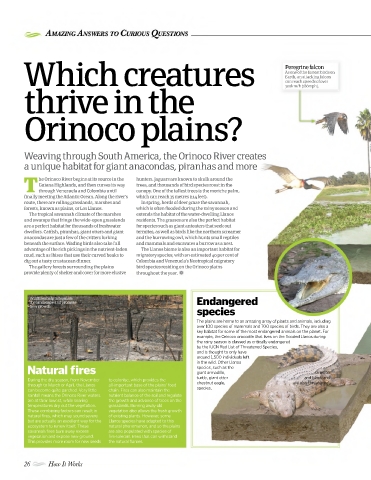
                                                                      The plains are home to an amazing array of plants and animals, including
                                                                      over 100 species of mammals and 700 species of birds. They are also a
                                                                      key habitat for some of the most endangered animals on the planet. For
                                                                      example, the Orinoco crocodile that lives on the flooded Llanos during

                                                                      the rainy season is classed as critically endangered
                                                                      by the IUCN Red List of Threatened Species,
                                                                      and is thought to only have
                                                                      around 1,500 individuals left
                                                                      in the wild. Other Llanos
           Natural fi         res                                      species, such as the                      Orinoco
                                                                      giant armadillo,
                                                                      turtle, giant otter                   and black-and-
           During the dry season, from November   to colonise, which provides the
           through to March or April, the Llanos   all-important base of the plains’ food   chestnut eagle,   are also threatened
           can become quite parched. Very little   chain. Fires can also maintain the   species.
           rainfall means the Orinoco River waters   nutrient balance of the soil and regulate
           are at their lowest, while soaring   the growth and advance of trees on the
           temperatures dry out the vegetation.   grasslands. Burning away old
           These combining factors can result in   vegetation also allows the fresh growth
           natural fires, which may sound severe   of existing plants. However, some

           but are actually an excellent way for the   Llanos species have adapted to this
           ecosystem to renew itself. These   natural phenomenon, and so the plains
           savannah fires burn away excess   are also populated with species of

           vegetation and expose new ground.   fire-tolerant trees that can withstand

           This provides more room for new seeds   the natural fl ames.
          26       How It Works

