


Page 25 - How It Works - Book Of Amazing Answers To Curious Questions, Volume 05-15
P. 25
Environment


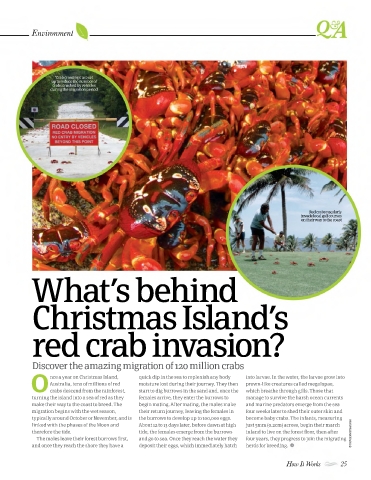
                    ‘Crab crossings’ are set
                   up to reduce the number of
                   crabs crushed by vehicles
                   during the migration period


                                                                                                              Red crabs regularly
                                                                                                           invade local golf courses
                                                                                                           on their way to the coast


            What’s behind


            Christmas Island’s


            red                crab                   invasion?


            Discover the amazing migration of 120 million crabs

                   nce a year on Christmas Island,   quick dip in the sea to replenish any body   into larvae. In the water, the larvae grow into
                   Australia, tens of millions of red   moisture lost during their journey. They then   prawn-like creatures called megalopae,
            Ocrabs descend from the rainforest,   start to dig burrows in the sand and, once the   which breathe through gills. Those that
            turning the island into a sea of red as they   females arrive, they enter the burrows to   manage to survive the harsh ocean currents
            make their way to the coast to breed. The   begin mating. After mating, the males make   and marine predators emerge from the sea
            migration begins with the wet season,   their return journey, leaving the females in   four weeks later to shed their outer skin and
            typically around October or November, and is   the burrows to develop up to 100,000 eggs.   become baby crabs. The infants, measuring
            linked with the phases of the Moon and   About 12 to 13 days later, before dawn at high   just 5mm (0.2cm) across, begin their march
            therefore the tide.                   tide, the females emerge from the burrows   inland to live on the forest floor, then after   © Corbis; Rex Features
              The males leave their forest burrows first,   and go to sea. Once they reach the water they   four years, they progress to join the migrating
            and once they reach the shore they have a   deposit their eggs, which immediately hatch   herds for breeding.


                                                                                                      How It Works        25

