


Page 82 - How It Works - Book Of Amazing Answers To Curious Questions, Volume 05-15
P. 82
What is anxiety?


          How our brains trigger a fight or fl          ight response

               nxiety affects a huge number of people   When we become anxious our fight or fl ight

               and can be so severe that it stops many   response is triggered, causing our bodies to

         Asufferers from leaving their homes or   flood with epinephrine (adrenaline),
          doing their jobs. In the US, over 40 million   norepinephrine (noradrenaline) and cortisol,

          people aged 18 or over endure an anxiety   which help increase your reflexes and reaction
          related disorder, while in the UK one in 20   speed. Your body prepares itself to deal with
          people are affected. Some researchers believe   danger by increasing the heart rate, pumping
          that modern day technology has infl uenced the   more blood to the muscles and by getting the
          rise of anxiety related conditions; we are   lungs to hyperventilate.
          constantly on high alert with texts, emails,   At the same time, the brain stops thinking
          social media and news updates.      about pleasurable things, making sure that all
           Anxiety is a natural human response that   of its focus is on identifying potential threats. In
          serves a purpose. From a biological point of   extreme cases, the body will respond to
          view, it functions to create a heightened sense   anxiety by emptying the digestive tract by any   Some people who suffer
          of awareness, preparing us for potential   means necessary, as this ensures that no   anxiety find it hard to
                                                                                    leave the house
          threats. In a way, it’s nature’s panic button.   energy is wasted on digestion.

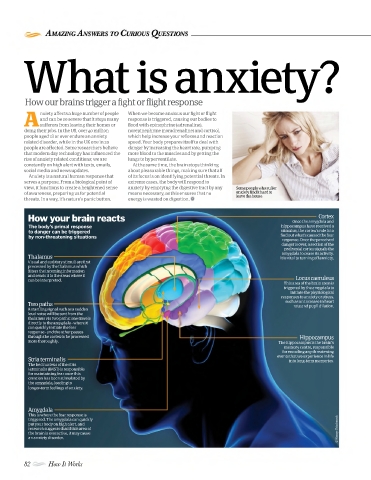
                                                                                                                 Cortex
           How your brain reacts                                                                        Once the amygdala and
           The body’s primal response                                                               hippocampus have received a
           to danger can be triggered                                                               stimulus, the cortex’s role is to

           by non-threatening situations                                                            find out what’s caused the fear
                                                                                                    response. Once the perceived
                                                                                                    danger is over, a section of the
                                                                                                     prefrontal cortex signals the
                                                                                                    amygdala to cease its activity.
           Thalamus                                                                                 It is vital to turning off anxiety.
           Visual and auditory stimuli are fi rst
           processed by the thalamus which
           filters the incoming information

           and sends it to the areas where it                                                            Locus caeruleus
           can be interpreted.
                                                                                                     This area of the brain stem is
                                                                                                     triggered by the amygdala to
                                                                                                       initiate the physiological
                                                                                                    responses to anxiety or stress,
                                                                                                     such as an increase in heart
           Two paths                                                                                    rate and pupil dilation.
           A startling signal such as a sudden
           loud noise will be sent from the
           thalamus via two paths: one travels
           directly to the amygdala - where it
           can quickly initiate the fear
           response - and the other passes
           through the cortex to be processed                                                             Hippocampus
           more thoroughly.                                                                        The hippocampus is the brain’s
                                                                                                     memory centre, responsible
                                                                                                    for encoding any threatening
                                                                                                  events that we experience in life
           Stria terminalis                                                                            into long-term memories.
           The bed nucleus of the stria
           terminalis (BNST) is responsible
           for maintaining fear once this
           emotion has been stimulated by
           the amygdala, leading to
           longer-term feelings of anxiety.
           Amygdala
           This is where the fear response is
           triggered. The amygdala can quickly
           put your body on high alert, and
           research suggests that if this area of                                                                       © Alamy; Thinkstock
           the brain is overactive, it may cause
           an anxiety disorder.


          82       How It Works

