


Page 85 - How It Works - Book Of Amazing Answers To Curious Questions, Volume 05-15
P. 85
Science


            Why do we get cravings?


            Is a child destined to develop a taste for all things sweet?
                   unger and cravings are two very   diet can influence our preferences for certain   conversation can cause our appetite and
                   different things. While one is about   foods. Scientists have found that flavours are   cravings to change. The gut bacteria are also
            H survival, the other satisfies the    transmitted from mother to baby via the   heavily involved; when they break down large
            nagging need for something sugar-filled.   amniotic fluid surrounding the foetus in the   quantities of fibre, they produce a specific
              It’s believed we all develop a taste for   womb. Once born, the probability of the child   compound that is sent to the brain, triggering it
            sweetness in infancy, which is said to stem   disliking the flavours they have already   to feel full and satisfied from the recently
            from the predominant sweet taste of our   experienced is reduced.          ingested meal.
            mother’s milk; when we taste it, the brain’s   Our gut also plays a large role in cravings. The   So should we consider cravings as a sign of
            reward centres light up, causing us to derive   gut contains an almost separate autonomous   food addiction? Although high-sugar and
            pleasure from this experience. As we continue   system that governs the digestion lining. This   high-fat foods exhibit some of the hallmarks of
            to consume our mother’s milk this pleasure is   vast network of 100 million neurones constantly   addiction, the consensus is that it’s actually the
            reinforced, which could explain how our sugar   samples the ingested food, relaying this   behaviour around eating these foods that we
            cravings originate. What’s more, our mothers’   information to the brain. This endless   are addicted to.


                                                                                         Tricking our senses
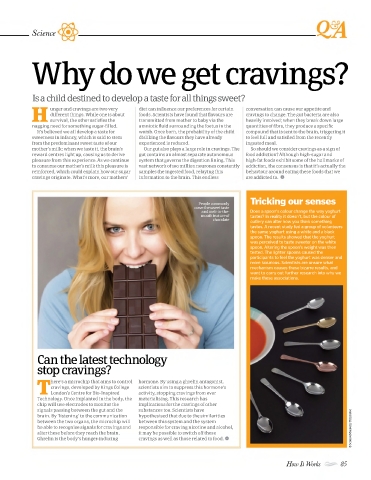
                                                                       People commonly
                                                                     crave the sweet taste
                                                                        and melt-in-the-  Does a spoon’s colour change the way yoghurt
                                                                        mouth texture of   tastes? In reality it doesn’t, but the colour of
                                                                            chocolate    cutlery can alter how you think something
                                                                                         tastes. A recent study fed a group of volunteers
                                                                                         the same yoghurt using a white and a black
                                                                                         spoon. The results showed that the yoghurt
                                                                                         was perceived to taste sweeter on the white
                                                                                         spoon. Altering the spoon’s weight was then
                                                                                         tested. The lighter spoons caused the
                                                                                         participants to feel the yoghurt was denser and
                                                                                         more luxurious. Scientists are unsure what
                                                                                         mechanism causes these bizarre results, and
                                                                                         want to carry out further research into why we
                                                                                         make these associations.


              Can the latest technology
              stop cravings?

                   here’s a microchip that aims to control   hormone. By using a ghrelin antagonist,
                   cravings, developed by Kings College   scientists aim to suppress this hormone’s
              TLondon’s Centre for Bio-Inspired   activity, stopping cravings from ever
              Technology. Once implanted in the body, the   materialising. This research has
              chip will use electrodes to monitor the   implications for the cravings of other
              signals passing between the gut and the   substances too. Scientists have
              brain. By ‘listening’ to the communication   hypothesised that due to the similarities
              between the two organs, the microchip will   between this system and the system
              be able to recognise signals for cravings and   responsible for craving nicotine and alcohol,                 © Science Museum; Thinkstoc
              alter these before they reach the brain.   it may be possible to switch off these
              Ghrelin is the body’s hunger-inducing   cravings as well as those related to food.


                                                                                                      How It Works        85

