


Page 87 - How It Works - Book Of Amazing Answers To Curious Questions, Volume 05-15
P. 87
Science


             What is keratin?                                                     Alpha keratin
                                                                                  How this protein makes up your hair

            The secret behind some of nature’s                                    Alpha helix
                                                                                  Keratin is made of coils of
            toughest materials                                                    amino acids held together
                                                                                  by peptide bonds to form
                                                                                  polypeptide chains.
                  eratin is a protein found in humans and
                  animals alike. There are two main
            Ktypes and each has a slightly different                              Protofibril
                                                                                  Three alpha helices twist
             structure. Alpha keratin, which is the main
                                                                                  together to form a protofi bril,
             structural component of hair, skin, nails, hooves                    the first step towards creating

             and the wool of animals has a coiled shape,                          a hair fi bre.
             whereas the tougher beta keratin, found in bird
             beaks and reptile scales, consists of parallel
             sheets. Both are composed of amino acids –                           Microfibril
             the building blocks of all proteins that make up                     An 11-stranded cable is formed
             a large proportion of our cells, muscles and                         by nine protofi bril joining
                                                                                  together in a circle around two
             other tissues.
                                                                                  more protofi bril strands.
              The flexibility of the keratin depends on the

             proportion of different amino acids present.
             One particular amino acid, called cysteine, is                       Macrofibril
                                                                                  Hundreds of microfi brils
             responsible for forming disulphide bridges that                      bundle together in an irregular
             bond the keratin together and give it its                            structure to create a
             strength. The more cysteine the keratin                              macrofi bril.
             contains, the stronger the bonds will be, so more
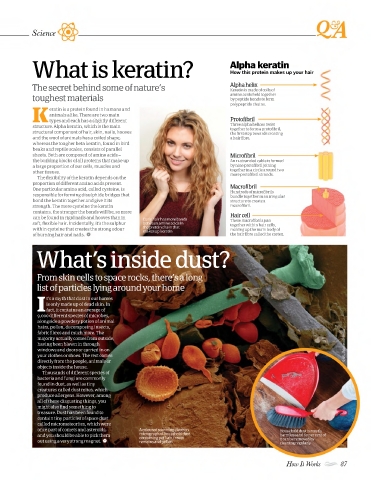
             can be found in rigid nails and hooves than in   Curly hair has more bonds   Hair cell
                                                                                  These macrofi brils join

             soft, flexible hair. Incidentally, it’s the sulphur   between amino acids in   together within hair cells,
             within cysteine that creates the strong odour   the protein chain that   making up the main body of
                                                   makes up keratin

             of burning hair and nails.                                           the hair fibre called the cortex.
              What’s inside dust?
              From skin cells to space rocks, there’s a long
              list of particles lying around your home

                 t’s a myth that dust in our homes
                 is only made up of dead skin. In
              Ifact, it contains an average of
              9,000 different species of microbes,
              alongside a powdery potion of animal
              hairs, pollen, decomposing insects,
              fabric fibres and much more. The

              majority actually comes from outside,
              having been blown in through                                                                                © SPL; Thinkstock; Corbis
              windows and doors or carried in on
              your clothes or shoes. The rest comes
              directly from the people, animals or
              objects inside the house.
                Thousands of different species of
              bacteria and fungi are commonly
              found in dust, as well as tiny
              creatures called dust mites, which
              produce allergens. However, among
              all of these disgusting things, you
              might also find something to

              treasure. Dust has been found to
              contain tiny particles of space dust
              called micrometeorites, which were
              once part of comets and asteroids,   A coloured scanning electron                    Household dust is mostly
              and you should be able to pick them   micrograph of household dust                   harmless and 80 per cent of
                                                  containing pet hair, insect
              out using a very strong magnet.     remains and pollen                               it can be removed by
                                                                                                   cleaning regularly

                                                                                                      How It Works        87

