


Page 84 - How It Works - Book Of Amazing Answers To Curious Questions, Volume 05-15
P. 84
How do suntans


         develop?                                      Find out how our skin reacts to being


                                                       exposed to the Sun


                 edical professionals continue to warn   melanocytes in our skin to react by producing   melanoyctes’ DNA, which can lead to a deadly
                 us about the dangers of exposing our   more melanin pigment. Melanin is the pigment   form of skin cancer known as melanoma.
         Mskin to too much sunlight. In spite of   responsible for our skin’s colour and it protects   Recent science suggests the process of tanning
         this, many of us still spend too long sunbathing   the cells by absorbing UV radiation that would   has addictive qualities. An experiment using
         in the hope of achieving the even bronzing that   otherwise damage skin cells. People with   mice showed that as well as producing melanin,
         so many celebrities fl aunt.           naturally darker skin have more melanin and so   UV radiation produced pleasure chemicals
           When we expose our skin to strong sunlight or   are inherently better protected against sunlight.   called endorphins, which are also produced
         a sunbed, the UV radiation we absorb prompts   Nevertheless, excessive UV exposure damages   after a person ingests addictive drugs.

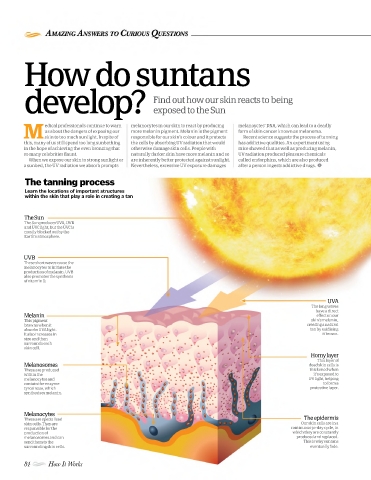
          The tanning process
          Learn the locations of important structures
          within the skin that play a role in creating a tan


          The Sun
          The Sun produces UVA, UVB
          and UVC light, but the UVC is
          mostly blocked out by the
          Earth’s atmosphere.


         UVB
         These short waves cause the
         melanocytes to initiate the
         production of melanin. UVB
         also promotes the synthesis
         of vitamin D.


                                                                                                                    UVA
                                                                                                              The long waves
                                                                                                                have a direct
          Melanin                                                                                               effect on our
          This pigment                                                                                        skin’s melanin,
          browns when it                                                                                     creating a natural
          absorbs UVA light.                                                                                  tan by oxidising
          It also increases in                                                                                    it brown.
          size and then
          surrounds each
          skin cell.
                                                                                                              Horny layer
                                                                                                                This layer of
          Melanosomes                                                                                         dead skin cells is
          These are produced                                                                                  thickened when
          within the                                                                                           it’s exposed to
          melanocytes and                                                                                     UV light, helping
          contain the enzyme                                                                                       to form a
          tyrosinase, which                                                                                   protective layer.
          synthesises melanin.


          Melanocytes
          These are specialised                                                                             The epidermis
          skin cells. They are                                                                             Our skin cells are in a
          responsible for the                                                                          continuous 30-day cycle, in
          production of                                                                                 which they are constantly
          melanosomes and can                                                                            produced and replaced.
          send them to the                                                                                  This is why suntans
          surrounding skin cells.                                                                             eventually fade.

          84       How It Works

