


Page 83 - How It Works - Book Of Amazing Answers To Curious Questions, Volume 05-15
P. 83
Science


            How do Bunsen burners work?


            Find out how its flame reaches temperatures of up to 1,200°C
                                                                                                  obert Bunsen invented the Bunsen
                                                                                                  burner in the mid-19th century as
                                                                                           R a means to an end. The German
                                                                                            chemist’s work focused on emission
                                                                                            spectra, which is the bright light produced
                                                                                            by different elements when they are

                                                                                            heated in a flame. To carry out this
                                                                                            experiment he required a hot, clean fl ame,
                                                                                            which gave him the idea for the Bunsen
                                                                                            burner. A modern Bunsen burner consists
                                                                                            of a straight metal tube, measuring about
                                                                                            13 centimetres (five inches) long, attached

                                                                                            to a base stand. A thin rubber tube known
                                                                                            as a gas hose connects to the bottom and
                                                                                            supplies gas to the Bunsen. The metal
                                                                                            collar works to adjust the amount of air
                                                                                            that enters the tube by altering the size of
                                                                                            the air hole at the base. By allowing air and
                                                                                            therefore oxygen to mix with the gas, a
                                                                                            hotter and more complete reaction occurs,

                                                                                            causing a very hot, blue flame to  be
                                                                                            produced. The Bunsen still has an
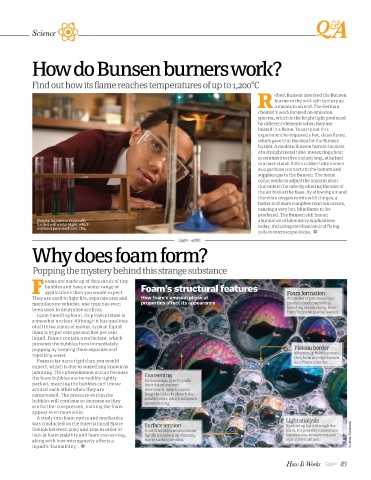
              Bunsen burners are typically                                                  abundance of laboratory applications
              fuelled with natural gas, which                                               today, including sterilisation and fi xing
              is almost pure methane, CH4
                                                                                            cells to microscope slides.

            Why does foam form?


            Popping the mystery behind this strange substance

                 oams are made up of thousands of tiny
                 bubbles and have a wider range of   Foam’s structural features
            Fapplications than you would expect.

            They are used to fi ght fire, separate ores and   How foam’s unusual physical
            manufacture vehicles; one type has even   properties affect its appearance
            been used to neutralise anthrax.
              Upon handling foam, its physical state is
            somewhat unclear. Although it has qualities
            of all three states of matter, typical liquid
            foam is 95 per cent gas and five per cent

            liquid. Foams contain a surfactant, which
            prevents the bubbles from immediately
            popping by keeping them separate and
            repelling water.
              Foam is far more rigid than you would
            expect, which is due to something known as
            jamming. This phenomenon occurs because
            the foam bubbles are incredibly tightly
            packed, meaning the bubbles can’t move
            around each other when they are
            compressed. The pressure within the
            bubbles will continue to increase as they
            are further compressed, making the foam
            appear even more solid.
              A study into foam optics and mechanics
            was conducted on the International Space
            Station between 2009 and 2010 in order to
            look at foam stability and foam coarsening,                                                                     © Corbis; Thinkstock
            along with how microgravity affects a
            liquid’s ‘foamability’.


                                                                                                      How It Works        83

