


Page 86 - How It Works - Book Of Amazing Answers To Curious Questions, Volume 05-15
P. 86
How do fi                                  reworks


         make shapes?                                                      The chemistry behind the

                                                                           spectacular patterns in the sky


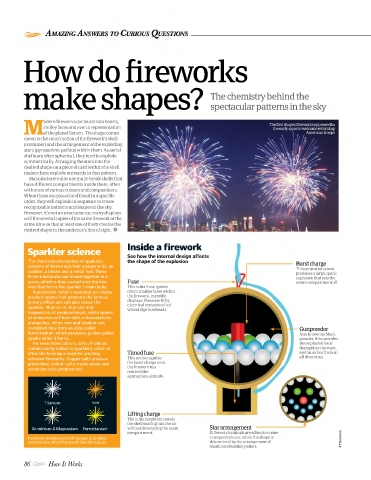
                odern fireworks can burst into hearts,                                           The first shaped fireworks appeared in

                smiley faces and even a representation                                           the early 1990s to welcome returning
         Mof the planet Saturn. The shape comes                                                              American troops
         down to the construction of the fi rework’s shell
         (container) and the arrangement of the exploding
         stars (pyrotechnic pellets) within them. As aerial
         shells are often spherical, they tend to explode
         symmetrically. Arranging the stars into the
         desired shape on a piece of card within the shell
         makes them explode outwards in that pattern.
           Manufacturers also use multi-break shells that
         have different compartments inside them, often
         with stars of various colours and compositions.
         When these are placed and fused in a specifi c
         order, they will explode in sequence to create
         recognisable patterns and shapes in the sky.
         However, it’s not an exact science; many displays
         will fire several copies of the same firework at the


         same time so that at least one of them creates the
         desired shape in the audience’s line of sight.
                                              Inside a fi     rework
           Sparkler science
                                              See how the internal design affects
           The chemical composition of sparklers   the shape of the explosion                            Burst charge
           consists of three important components: an                                                    This central structure
           oxidiser, a binder and a metal fuel. These                                                    produces a large, quick
           three substances are bound together in a                                                      explosion that sets the
           paste, which is then coated onto the iron   Fuse                                              entire compartment off.
           wire that forms the sparkler’s main body.   This initial fuse ignites
             A powdered metal is essential, as it helps   other, smaller fuses within

           produce sparks that generate the famous   the firework. In public
           glittery effect and can also colour the   displays, these are lit by
                                              electrical contacts called
           sparkler. Aluminium, titanium and   wirebridge fuseheads.
           magnesium all produce bright, white sparks,
           whereas iron will burn with a characteristic
           orange hue. When iron and titanium are
           combined they form an alloy called                                                             Gunpowder
           ferrotitanium, which produces golden yellow                                                    Also known as black
           sparks when it burns.                                                                          powder, this provides
             For even more colours, salts of various                                                      the explosive force
           metals can be added to sparklers, which is                                                     that ignites the stars
           often the technique used for creating   Timed fuse                                             and launches them in

           coloured fireworks. Copper salts produce   This section ignites                                 all directions.
           green-blue, barium salts create green and   the burst charge once
           strontium salts produce red.       the fi rework has
                                              reached the
                                              appropriate altitude.


                 Titanium        Iron
                                              Lifting charge
                                              The initial explosion sends
                                              the shell soaring into the air
            Aluminium & Magnesium  Ferrotitanium  without detonating the main   Star arrangement
                                              compartment.                 Different chemicals are added to create
           Powdered metals react with oxygen to produce                    a range of colours, while the shape is        © Thinkstock
           metal oxides, which burn with specific colours                  determined by the arrangement of
                                                                           small, combustible pellets.

          86       How It Works

