


Page 197 - The Dinosaur Book and Other Wonders of the Prehistoric World (DK-Smithsonian)
P. 197
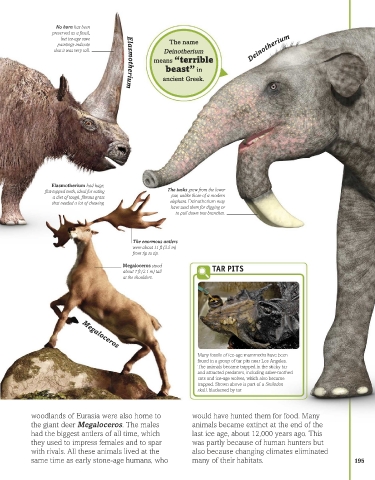
No horn has been
                  preserved as a fossil,
                     but ice-age cave                   The name
                    paintings indicate                                             Deinotherium
                   that it was very tall.              Deinotherium
                                                   means “terrible
                                                       beast” in
                                                      ancient Greek.

                                           Elasmotherium


                  Elasmotherium had huge,
                flat-topped teeth, ideal for eating     The tusks grew from the lower
                  a diet of tough, fibrous grass         jaw, unlike those of a modern
                  that needed a lot of chewing.          elephant. Deinotherium may
                                                         have used them for digging or
                                                          to pull down tree branches.


                                            The enormous antlers
                                            were about 11 ft (3.5 m)
                                            from tip to tip.

                                         Megaloceros stood            TAR PITS
                                         about 7 ft (2.1 m) tall
                                         at the shoulders.


                            Megaloceros
                                                                  Many fossils of ice-age mammoths have been
                                                                  found in a group of tar pits near Los Angeles.
                                                                  The animals became trapped in the sticky tar
                                                                  and attracted predators, including saber-toothed
                                                                  cats and ice-age wolves, which also became
                                                                  trapped. Shown above is part of a Smilodon
                                                                  skull, blackened by tar.


           woodlands of Eurasia were also home to               would have hunted them for food. Many
           the giant deer Megaloceros. The males                animals became extinct at the end of the
           had the biggest antlers of all time, which           last ice age, about 12,000 years ago. This
           they used to impress females and to spar             was partly because of human hunters but
           with rivals. All these animals lived at the          also because changing climates eliminated
           same time as early stone-age humans, who             many of their habitats.                              195


   US_192-195_Ice-age_Giants.indd   195                                                                          10/04/18   3:35 PM

