


Page 40 - The Dinosaur Book and Other Wonders of the Prehistoric World (DK-Smithsonian)
P. 40
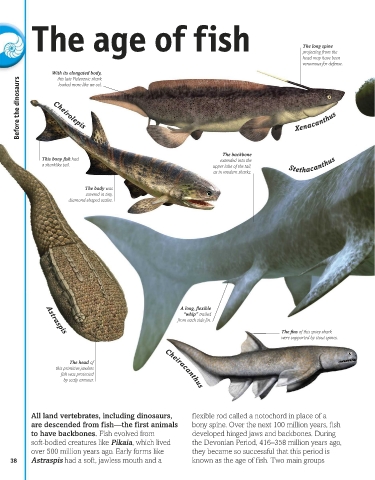
The age of f ish                                                                         The long spine


                                                                                                    projecting from the
                                                                                                    head may have been
                                                                                                    venomous for defense.
                  With its elongated body,
                    this late Paleozoic shark
       Before the dinosaurs  Cheirolepis                                                         Xenacanthus
                    looked more like an eel.


                                                                          The backbone
               This bony fish had                                        extended into the
               a sharklike tail.                                      upper lobe of the tail,   Stethacanthus
                                                                       as in modern sharks.


                             The body was
                             covered in tiny,
                       diamond-shaped scales.


                                                            A long, flexible
                                                             “whip” trailed
                                                           from each side fin.
                                                                                             The fins of this spiny shark
                Astraspis
                                                                                             were supported by stout spines.


                        The head of
                   this primitive jawless              Cheiracanthus
                     fish was protected
                      by scaly armour.


           All land vertebrates, including dinosaurs,           flexible rod called a notochord in place of a
           are descended from fish—the first animals            bony spine. Over the next 100 million years, fish
           to have backbones. Fish evolved from                 developed hinged jaws and backbones. During
           soft-bodied creatures like Pikaia, which lived       the Devonian Period, 416–358 million years ago,
           over 500 million years ago. Early forms like         they became so successful that this period is
    38     Astraspis had a soft, jawless mouth and a            known as the age of fish. Two main groups


   US_038-039_The_Age_of_fish.indd   38                                                                          23/04/18   6:16 PM

