


Page 41 - The Dinosaur Book and Other Wonders of the Prehistoric World (DK-Smithsonian)
P. 41
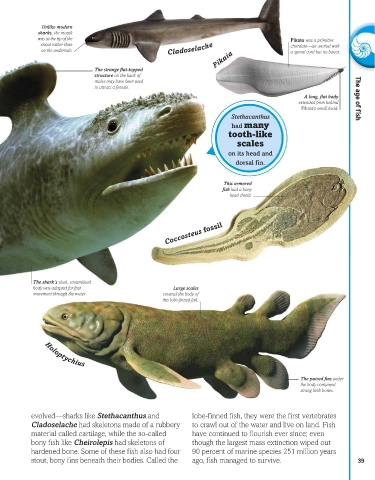
Unlike modern
             sharks, the mouth
             was at the tip of the                                                              Pikaia was a primitive
              snout rather than                                                                 chordate—an animal with
              on the underside.                         Cladoselache                            a spinal cord but no bones.
                                                                       Pikaia

                                The strange flat-topped
                                structure on the back of
                                males may have been used
                                to attract a female.
                                                                                                    A long, flat body   The age of f
                                                                                                   extended from behind
                                                                                                   Pikaia’s small head.
                                                                            Stethacanthus                            ish
                                                                             had many
                                                                            tooth-like

                                                                              scales
                                                                            on its head and
                                                                              dorsal fin.


                                                                          This armored
                                                                          fish had a bony
                                                                            head shield.


                                                       Coccosteus fossil


            The shark’s sleek, streamlined
            body was adapted for fast                     Large scales
            movement through the water.               covered the body of
                                                      this lobe-finned fish.


                Holoptychius


                                                                                                   The paired fins under
                                                                                                   the body contained
                                                                                                   strong limb bones.


           evolved—sharks like Stethacanthus and                lobe-finned fish, they were the first vertebrates
           Cladoselache had skeletons made of a rubbery         to crawl out of the water and live on land. Fish
           material called cartilage, while the so-called       have continued to flourish ever since; even
           bony fish like Cheirolepis had skeletons of          though the largest mass extinction wiped out
           hardened bone. Some of these fish also had four      90 percent of marine species 251 million years
           stout, bony fins beneath their bodies. Called the    ago, fish managed to survive.                         39


   US_038-039_The_Age_of_fish.indd   39                                                                          26/04/18   3:30 PM

