


Page 115 - Complete Birds of Britain and Europe (DK - RSPB)
P. 115
WILDFOWL
       Order Anseriformes     Family Anatidae        Species Melanitta fusca
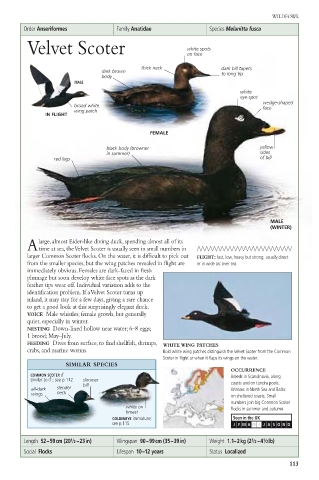
        Velvet Scoter                          white spots
                                               on face
                                    thick neck          dark bill tapers
                          dark brown                    to long tip
                          body
                    MALE
                                                             white
                                                             eye-spot
                                                                  wedge-shaped
                   broad white                                    face
                   wing patch
            IN FLIGHT
                                      FEMALE

                           black body (browner                    yellow
                           in summer)                             sides
              red legs                                            of bill


                                                                    MALE
                                                                    (WINTER)
           large, almost Eider-like diving duck, spending almost all of its
        A time at sea, the Velvet Scoter is usually seen in small numbers in
        larger Common Scoter flocks. On the water, it is difficult to pick out  FLIGHT: fast, low, heavy but strong; usually direct
        from the smaller species, but the wing patches revealed in flight are  or in wide arc over sea.
        immediately obvious. Females are dark-faced in fresh
        plumage but soon develop white face spots as the dark
        feather tips wear off. Individual variation adds to the
        identification problem. If a Velvet Scoter turns up
        inland, it may stay for a few days, giving a rare chance
        to get a good look at this surprisingly elegant duck.
        VOICE Male whistles; female growls, but generally
        quiet, especially in winter.
        NESTING Down-lined hollow near water; 6–8 eggs;
        1 brood; May–July.
        FEEDING Dives from surface, to find shellfish, shrimps,  WHITE WING PATCHES
        crabs, and marine worms.          Bold white wing patches distinguish the Velvet Scoter from the Common
                                          Scoter in flight or when it flaps its wings on the water.
                 SIMILAR SPECIES
                                                          OCCURRENCE
         COMMON SCOTER 3                                  Breeds in Scandinavia, along
         similar to 3; see p.112  slimmer
                      bill                                coasts and on tundra pools.
         all-dark  slender                                Winters in North Sea and Baltic
         wings  neck
                                                          on sheltered coasts. Small
                                                          numbers join big Common Scoter
                                white on                  flocks in summer and autumn.
                                breast
                             GOLDENEYE immature;           Seen in the UK
                             see p.115                     JF M A  M J  J AS ON D
       Length  52–59cm (20 1 ⁄2 –23in)  Wingspan  90–99cm (35–39in)  Weight  1.1–2kg (2 1 ⁄2 –4 1 ⁄2lb)
       Social  Flocks         Lifespan  10–12 years  Status  Localized
                                                                         113

