


Page 114 - Complete Birds of Britain and Europe (DK - RSPB)
P. 114
WILDFOWL
       Order Anseriformes     Family Anatidae        Species Melanitta nigra
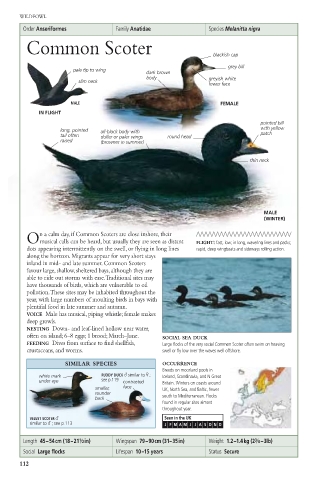
        Common Scoter
                                                      blackish cap
                                                          grey bill
                   pale tip to wing
                                     dark brown
                                     body            greyish white
                     slim neck
                                                     lower face
                   MALE                                 FEMALE
           IN FLIGHT
                                                                  pointed bill
                                                                  with yellow
                long, pointed  all-black body with
                tail often  duller or paler wings  round head     patch
                raised    (browner in summer)
                                                               thin neck


                                                                   MALE
                                                                   (WINTER)
           n a calm day, if Common Scoters are close inshore, their
        Omusical calls can be heard, but usually they are seen as distant  FLIGHT: fast, low; in long, wavering lines and packs;
        dots appearing intermittently on the swell, or flying in long lines  rapid, deep wingbeats and sideways rolling action.
        along the horizon. Migrants appear for very short stays
        inland in mid- and late summer. Common Scoters
        favour large, shallow, sheltered bays, although they are
        able to ride out storms with ease.Traditional sites may
        have thousands of birds, which are vulnerable to oil
        pollution.These sites may be inhabited throughout the
        year, with large numbers of moulting birds in bays with
        plentiful food in late summer and autumn.
        VOICE Male has musical, piping whistle; female makes
        deep growls.
        NESTING Down- and leaf-lined hollow near water,
        often on island; 6–8 eggs; 1 brood; March–June.  SOCIAL SEA DUCK
        FEEDING Dives from surface to find shellfish,  Large flocks of the very social Common Scoter often swim on heaving
        crustaceans, and worms.          swell or fly low over the waves well offshore.
                 SIMILAR SPECIES         OCCURRENCE
                                         Breeds on moorland pools in
           white mark     RUDDY DUCK 3similar to 2;  Iceland, Scandinavia, and N Great
           under eye      see p.119  contrasted  Britain. Winters on coasts around
                         smaller,  face  UK, North Sea, and Baltic, fewer
                         rounder         south to Mediterranean. Flocks
                         back
                                         found in regular sites almost
                                         throughout year.
        VELVET SCOTER 3                   Seen in the UK
        similar to 3; see p.113           J  F  M  A  M  JJ A S O  N  D
       Length  45–54cm (18–21 1 ⁄2in)  Wingspan  79–90cm (31–35in)  Weight  1.2–1.4kg (2 3 ⁄4 –3lb)
       Social  Large flocks   Lifespan  10–15 years  Status  Secure
      112

