


Page 113 - Complete Birds of Britain and Europe (DK - RSPB)
P. 113
WILDFOWL
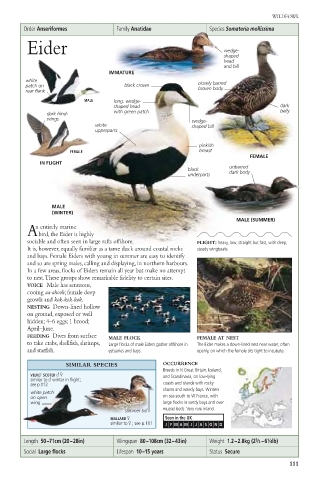
       Order Anseriformes     Family Anatidae        Species Somateria mollissima
        Eider                                            wedge-
                                                         shaped
                                                         head
                                                         and bill
                            IMMATURE
       white
       patch on                 black crown       closely barred
                                                  brown body
       rear flank
                      MALE   long, wedge-
                             shaped head                               dark
             dark hind-      with green patch                          belly
             wings
                                                 wedge-
                         white                   shaped bill
                         upperparts
                                                  pinkish
                  FEMALE                          breast
                                                               FEMALE
           IN FLIGHT
                                                black     unbarred
                                                underparts  dark body


              MALE
              (WINTER)
                                                            MALE (SUMMER)
          n entirely marine
        Abird, the Eider is highly
        sociable and often seen in large rafts offshore.  FLIGHT: heavy, low, straight but fast, with deep,
        It is, however, equally familiar as a tame duck around coastal rocks  steady wingbeats.
        and bays. Female Eiders with young in summer are easy to identify
        and so are spring males, calling and displaying, in northern harbours.
        In a few areas, flocks of Eiders remain all year but make no attempt
        to nest.These groups show remarkable fidelity to certain sites.
        VOICE Male has sensuous,
        cooing aa-ahooh; female deep
        growls and kok-kok-kok.
        NESTING Down-lined hollow
        on ground, exposed or well
        hidden; 4–6 eggs; 1 brood;
        April–June.
        FEEDING Dives from surface   MALE FLOCK   FEMALE AT NEST
        to take crabs, shellfish, shrimps,  Large flocks of male Eiders gather offshore in  The Eider makes a down-lined nest near water, often
        and starfish.       estuaries and bays.   openly, on which the female sits tight to incubate.
                 SIMILAR SPECIES          OCCURRENCE
                                          Breeds in N Great Britain, Iceland,
         VELVET SCOTER 32                 and Scandinavia, on low-lying
         similar to 3winter in flight;
         see p.113                        coasts and islands with rocky
                                          shores and weedy bays. Winters
         white patch
         on open                          on sea south to W France, with
         wing                             large flocks in sandy bays and over
                                          mussel beds. Very rare inland.
                                slimmer bill
                            MALLARD 2     Seen in the UK
                            similar to 2; see p.101  J  F  M  A  M  JJ A S O  N  D
       Length  50–71cm (20–28in)  Wingspan  80–108cm (32–43in)  Weight  1.2–2.8kg (2 3 ⁄4 –6 1 ⁄4lb)
       Social  Large flocks   Lifespan  10–15 years  Status  Secure
                                                                         111

