


Page 111 - Complete Birds of Britain and Europe (DK - RSPB)
P. 111
WILDFOWL
       Order Anseriformes     Family Anatidae        Species Aythya marila
                                                                 white blaze
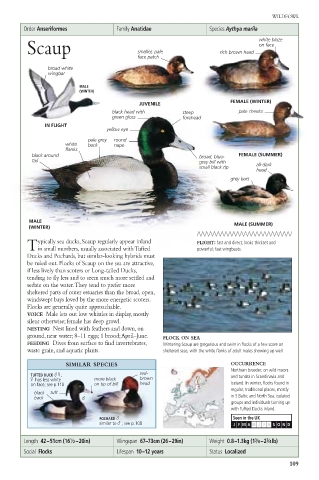
        Scaup                      smaller, pale        rich brown head  on face
                                   face patch
             broad white
             wingbar
                     MALE
                     (WINTER)
                                                          FEMALE (WINTER)
                                    JUVENILE
                             black head with  steep         pale cheeks
                             green gloss      forehead
            IN FLIGHT
                            yellow eye
                       pale grey  round
                 white  back  nape
                 flanks
         black around                             broad, blue-  FEMALE (SUMMER)
         tail                                     grey bill with
                                                  small black tip  all-dark
                                                                 head
                                                          grey bars


        MALE                                               MALE (SUMMER)
        (WINTER)
          ypically sea ducks, Scaup regularly appear inland  FLIGHT: fast and direct; looks thickset and
        Tin small numbers, usually associated with Tufted  powerful; fast wingbeats.
        Ducks and Pochards, but similar-looking hybrids must
        be ruled out. Flocks of Scaup on the sea are attractive,
        if less lively than scoters or Long-tailed Ducks,
        tending to fly less and to seem much more settled and
        sedate on the water.They tend to prefer more
        sheltered parts of outer estuaries than the broad, open,
        windswept bays loved by the more energetic scoters.
        Flocks are generally quite approachable.
        VOICE Male lets out low whistles in display, mostly
        silent otherwise; female has deep growl.
        NESTING Nest lined with feathers and down, on
        ground, near water; 8–11 eggs; 1 brood;April–June.  FLOCK ON SEA
        FEEDING Dives from surface to find invertebrates,  Wintering Scaup are gregarious and swim in flocks of a few score on
        waste grain, and aquatic plants.  sheltered seas, with the white flanks of adult males showing up well.
                 SIMILAR SPECIES                          OCCURRENCE
                                                          Northern breeder, on wild moors
         TUFTED DUCK 32;            red-                  and tundra in Scandinavia and
         2 has less white  more black  brown
         on face; see p.110  on tip of bill  head         Iceland. In winter, flocks found in
                                                          regular, traditional places, mostly
          black  tuft
          back       3                                    in S Baltic and North Sea, isolated
                                                          groups and individuals turning up
                                                          with Tufted Ducks inland.
                          POCHARD 3                        Seen in the UK
                          similar to 3; see p.108          J  F  M  A  M  JJ A S O  N  D
       Length  42–51cm (16 1 ⁄2 –20in)  Wingspan  67–73cm (26–29in)  Weight  0.8–1.3kg (1 3 ⁄4 –2 3 ⁄4lb)
       Social  Flocks         Lifespan  10–12 years  Status  Localized
                                                                         109

