


Page 159 - Complete Birds of Britain and Europe (DK - RSPB)
P. 159
RAILS, CRAKES,AND COOTS
       Order Gruiformes       Family Rallidae        Species Porzana porzana
        Spotted Crake


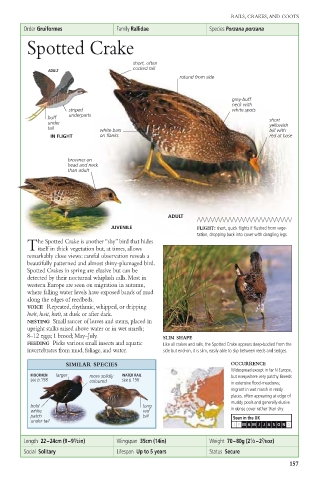
                                  short, often
                                  cocked tail
             ADULT
                                              rotund from side
                                                           grey-buff
                                                           neck with
                  striped                                  white spots
                  underparts
             buff                                                   short
             under                                                  yellowish
             tail         white bars                                bill with
              IN FLIGHT   on flanks                                 red at base
                  browner on
                  head and neck
                  than adult


                                           ADULT
                             JUVENILE             FLIGHT: short, quick flights if flushed from vege-
                                                  tation, dropping back into cover with dangling legs.
          he Spotted Crake is another “shy” bird that hides
        Titself in thick vegetation but, at times, allows
        remarkably close views: careful observation reveals a
        beautifully patterned and almost shiny-plumaged bird.
        Spotted Crakes in spring are elusive but can be
        detected by their nocturnal whiplash calls. Most in
        western Europe are seen on migration in autumn,
        where falling water levels have exposed bands of mud
        along the edges of reedbeds.
        VOICE Repeated, rhythmic, whipped, or dripping
        hwit, hwit, hwit, at dusk or after dark.
        NESTING Small saucer of leaves and stems, placed in
        upright stalks raised above water or in wet marsh;
        8–12 eggs; 1 brood; May–July.     SLIM SHAPE
        FEEDING Picks various small insects and aquatic  Like all crakes and rails, the Spotted Crake appears deep-bodied from the
        invertebrates from mud, foliage, and water.  side but end-on, it is slim, easily able to slip between reeds and sedges.
                 SIMILAR SPECIES                          OCCURRENCE
                                                          Widespread except in far N Europe,
         MOORHEN  larger  more solidly  WATER RAIL        but everywhere very patchy. Breeds
         see p.158     coloured  see p.156
                                                          in extensive flood-meadows;
                                                          migrant in wet marsh in reedy
                                                          places, often appearing at edge of
                                                          muddy pools and generally elusive
         bold                        long                 in dense cover rather than shy.
         white                       red
         patch                       bill                  Seen in the UK
         under tail
                                                           J  F  M  A  M  JJ A S O  N  D
       Length  22–24cm (9–9 1 ⁄2in)  Wingspan  35cm (14in)  Weight  70–80g (2 1 ⁄2 –2 7 ⁄8oz)
       Social  Solitary       Lifespan  Up to 5 years  Status  Secure
                                                                         157

