


Page 157 - Complete Birds of Britain and Europe (DK - RSPB)
P. 157
RAILS, CRAKES,AND COOTS
       Order Gruiformes       Family Rallidae        Species Crex crex
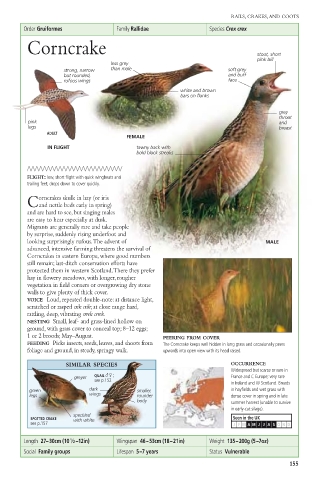
        Corncrake
                                                                 stout, short
                                                                 pink bill
                             less grey
                 strong, narrow  than male                soft grey
                 but rounded,                             and buff
                 rufous wings                             face
                                              white and brown
                                              bars on flanks
                                                                      grey
                                                                      throat
        pink                                                          and
        legs                                                          breast
             ADULT
                                FEMALE
             IN FLIGHT             tawny back with
                                   bold black streaks

        FLIGHT: low, short flight with quick wingbeats and
        trailing feet; drops down to cover quickly.
           orncrakes skulk in hay (or iris
        Cand nettle beds early in spring)
        and are hard to see, but singing males
        are easy to hear especially at dusk.
        Migrants are generally rare and take people
        by surprise, suddenly rising underfoot and
        looking surprisingly rufous.The advent of                  MALE
        advanced, intensive farming threatens the survival of
        Corncrakes in eastern Europe, where good numbers
        still remain; last-ditch conservation efforts have
        protected them in western Scotland.There they prefer
        hay in flowery meadows, with longer, rougher
        vegetation in field corners or overgrowing dry stone
        walls to give plenty of thick cover.
        VOICE Loud, repeated double-note: at distance light,
        scratched or rasped crik crik; at close range hard,
        rattling, deep, vibrating crrek crrek.
        NESTING Small, leaf- and grass-lined hollow on
        ground, with grass cover to conceal top; 8–12 eggs;
        1 or 2 broods; May–August.        PEERING FROM COVER
        FEEDING Picks insects, seeds, leaves, and shoots from  The Corncrake keeps well hidden in long grass and occasionally peers
        foliage and ground, in steady, springy walk.  upwards into open view with its head raised.
                 SIMILAR SPECIES                          OCCURRENCE
                                                          Widespread but scarce or rare in
                   greyer  QUAIL 32;                      France and C Europe; very rare
                        see p.152
                                                          in Ireland and W Scotland. Breeds
        green          dark        smaller,               in hayfields and wet grass with
        legs           wings       rounder                dense cover in spring and in late
                                   body                   summer harvest (unable to survive
                                                          in early-cut silage).
                   speckled
         SPOTTED CRAKE  with white                         Seen in the UK
         see p.157                                         JF M A  M J  JA S ON D
       Length  27–30cm (10 1 ⁄2 –12in)  Wingspan  46–53cm (18–21in)  Weight  135–200g (5–7oz)
       Social  Family groups  Lifespan  5–7 years    Status  Vulnerable
                                                                         155

