


Page 183 - Complete Birds of Britain and Europe (DK - RSPB)
P. 183
WADERS
       Order Charadriiformes  Family Scolopacidae    Species Calidris minuta
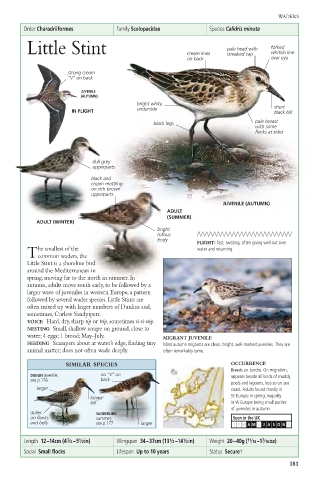
        Little Stint                                     pale head with  forked
                                                                    whitish line
                                               cream lines
                                               on back   streaked cap  over eye
                  strong cream
                  “V” on back
                     JUVENILE
                     (AUTUMN)
                                   bright white                      short
                   IN FLIGHT       underside                         black bill
                                       black legs               pale breast
                                                                with some
                                                                flecks at sides


                        dull grey
                        upperparts
                        black and
                        cream mottling
                        on rich brown
                        upperparts
                                                        JUVENILE (AUTUMN)
                                           ADULT
                                           (SUMMER)
          ADULT (WINTER)
                                        bright
                                        rufous
                                        body
                                                  FLIGHT: fast, twisting; often going well out over
          he smallest of the                      water and returning.
        Tcommon waders, the
        Little Stint is a shoreline bird
        around the Mediterranean in
        spring, moving far to the north in summer. In
        autumn, adults move south early, to be followed by a
        larger wave of juveniles in western Europe, a pattern
        followed by several wader species. Little Stints are
        often mixed up with larger numbers of Dunlins and,
        sometimes, Curlew Sandpipers.
        VOICE Hard, dry, sharp tip or trip, sometimes ti-ti-trip.
        NESTING Small, shallow scrape on ground, close to
        water; 4 eggs; 1 brood; May–July.  MIGRANT JUVENILE
        FEEDING Scampers about at water’s edge, finding tiny  Most autumn migrants are clean, bright, well-marked juveniles. They are
        animal matter; does not often wade deeply.  often remarkably tame.
                 SIMILAR SPECIES                          OCCURRENCE
                                                          Breeds on tundra. On migration,
         DUNLIN juvenile;  no “V” on                      appears beside all kinds of muddy
         see p.178        back
                                                          pools and lagoons, less so on sea
          larger                                          coast. Adults found mostly in
                                                          SE Europe in spring; majority
                       longer
                       bill                               in W Europe being small parties
                                                          of juveniles in autumn.
         duller          SANDERLING
         on flanks       summer;                           Seen in the UK
         and belly       see p.177  larger                 J  F  M  A  M  J JA S O  N  D
       Length  12–14cm (4 3 ⁄4 –5 1 ⁄2in)  Wingspan  34–37cm (13 1 ⁄2 –14 1 ⁄2in)  Weight  20–40g ( 11 ⁄16 –1 7 ⁄16oz)
       Social  Small flocks   Lifespan  Up to 10 years  Status  Secure†
                                                                         181

