


Page 188 - Complete Birds of Britain and Europe (DK - RSPB)
P. 188
WADERS
       Order Charadriiformes  Family Scolopacidae    Species Tringa ochropus
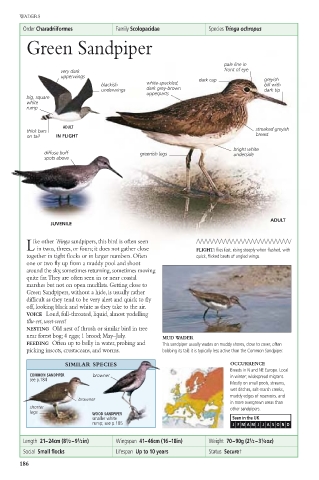
        Green Sandpiper


                                                         pale line in
                very dark                                front of eye
                upperwings                                         greyish
                                     white-speckled,  dark cap
                          blackish                                 bill with
                          underwings  dark grey-brown              dark tip
                                     upperparts
        big, square
        white
        rump
                 ADULT
        thick bars                                               streaked greyish
        on tail  IN FLIGHT                                       breast
                                                           bright white
            diffuse buff            greenish legs          underside
            spots above


                                                                    ADULT
              JUVENILE
         ike other Tringa sandpipers, this bird is often seen
        L in twos, threes, or fours; it does not gather close  FLIGHT: flies fast, rising steeply when flushed, with
        together in tight flocks or in larger numbers. Often  quick, flicked beats of angled wings.
        one or two fly up from a muddy pool and shoot
        around the sky,sometimes returning,sometimes moving
        quite far.They are often seen in or near coastal
        marshes but not on open mudflats. Getting close to
        Green Sandpipers, without a hide, is usually rather
        difficult as they tend to be very alert and quick to fly
        off, looking black and white as they take to the air.
        VOICE Loud, full-throated, liquid, almost yodelling
        tllu-eet, weet-weet!
        NESTING Old nest of thrush or similar bird in tree
        near forest bog; 4 eggs; 1 brood; May–July.  MUD WADER
        FEEDING Often up to belly in water, probing and  This sandpiper usually wades on muddy shores, close to cover, often
        picking insects, crustaceans, and worms.  bobbing its tail; it is typically less active than the Common Sandpiper.
                 SIMILAR SPECIES                          OCCURRENCE
                                                          Breeds in N and NE Europe. Local
        COMMON SANDPIPER  browner                         in winter; widespread migrant.
        see p.184
                                                          Mostly on small pools, streams,
                                                          wet ditches, salt-marsh creeks,
                                                          muddy edges of reservoirs, and
                    browner
                                                          in more overgrown areas than
        shorter                                           other sandpipers.
        legs            WOOD SANDPIPER
                        smaller white                      Seen in the UK
                        rump; see p.185                    J  F  M  A  M  JJ A S O  N  D
       Length  21–24cm (8 1 ⁄2 –9 1 ⁄2in)  Wingspan  41–46cm (16–18in)  Weight  70–90g (2 1 ⁄2 –3 1 ⁄4oz)
       Social  Small flocks   Lifespan  Up to 10 years  Status  Secure†
      186

