


Page 178 - Complete Birds of Britain and Europe (DK - RSPB)
P. 178
WADERS
       Order Charadriiformes  Family Scolopacidae    Species Calidris canutus
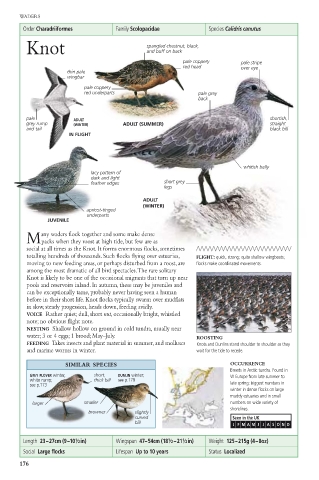
        Knot                         spangled chestnut, black,
                                     and buff on back
                                              pale coppery   pale stripe
                                              red head       over eye
                  thin pale
                  wingbar
                      pale coppery
                      red underparts              pale grey
                                                  back

        pale       ADULT                                            shortish,
        grey rump  (WINTER)     ADULT (SUMMER)                      straight
        and tail                                                    black bill
                  IN FLIGHT


                                                             whitish belly
                        lacy pattern of
                        dark and light
                        feather edges     short grey
                                          legs
                                     ADULT
                                     (WINTER)
                       apricot-tinged
                       underparts
             JUVENILE
           any waders flock together and some make dense
        Mpacks when they roost at high tide, but few are as
        social at all times as the Knot. It forms enormous flocks, sometimes
        totalling hundreds of thousands. Such flocks flying over estuaries,  FLIGHT: quick, strong; quite shallow wingbeats;
        moving to new feeding areas, or perhaps disturbed from a roost, are  flocks make coordinated movements.
        among the most dramatic of all bird spectacles.The rare solitary
        Knot is likely to be one of the occasional migrants that turn up near
        pools and reservoirs inland. In autumn, these may be juveniles and
        can be exceptionally tame, probably never having seen a human
        before in their short life. Knot flocks typically swarm over mudflats
        in slow, steady progession, heads down, feeding avidly.
        VOICE Rather quiet; dull, short nut, occasionally bright, whistled
        note; no obvious flight note.
        NESTING Shallow hollow on ground in cold tundra, usually near
        water; 3 or 4 eggs; 1 brood; May–July.    ROOSTING
        FEEDING Takes insects and plant material in summer, and molluscs  Knots and Dunlins stand shoulder to shoulder as they
        and marine worms in winter.               wait for the tide to recede.
                 SIMILAR SPECIES                          OCCURRENCE
                                                          Breeds in Arctic tundra. Found in
        GREY PLOVER winter,  short,  DUNLIN winter;       W Europe from late summer to
        white rump;     thick bill  see p.178
        see p.173                                         late spring; biggest numbers in
                                                          winter in dense flocks on large
                                                          muddy estuaries and in small
         larger       smaller                             numbers on wide variety of
                                                          shorelines.
                       browner     slightly
                                   curved                  Seen in the UK
                                   bill                    J  F  M  A  M  JJ A S O  N  D
       Length  23–27cm (9–10 1 ⁄2in)  Wingspan  47–54cm (18 1 ⁄2 –21 1 ⁄2in)  Weight  125–215g (4–8oz)
       Social  Large flocks   Lifespan  Up to 10 years  Status  Localized
      176

