


Page 187 - Complete Birds of Britain and Europe (DK - RSPB)
P. 187
WADERS
       Order Charadriiformes  Family Scolopacidae    Species Tringa glareola
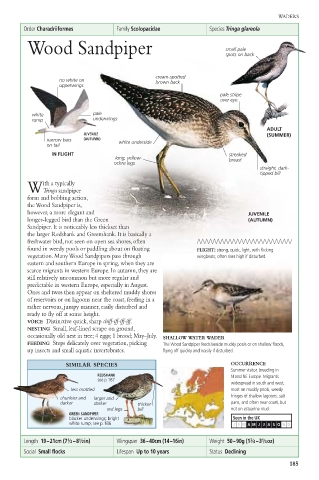
        Wood Sandpiper                                   small pale
                                                         spots on back


                                        cream-spotted
                no white on             brown back
                upperwings
                                                        pale stripe
                                                        over eye
         white          pale
         rump           underwings
                                                                   ADULT
                      JUVENILE                                     (SUMMER)
             narrow bars  (AUTUMN)  white underside
             on tail
              IN FLIGHT                                   streaked
                              long, yellow-               breast
                             ochre legs
                                                                  straight, dark-
                                                                  tipped bill
            ith a typically
        WTringa sandpiper
        form and bobbing action,
        the Wood Sandpiper is,
        however, a more elegant and                            JUVENILE
        longer-legged bird than the Green                      (AUTUMN)
        Sandpiper. It is noticeably less thickset than
        the larger Redshank and Greenshank. It is basically a
        freshwater bird, not seen on open sea shores, often
        found in weedy pools or paddling about on floating  FLIGHT: strong, quick, light, with flicking
        vegetation. Many Wood Sandpipers pass through  wingbeats; often rises high if disturbed.
        eastern and southern Europe in spring, when they are
        scarce migrants in western Europe. In autumn, they are
        still relatively uncommon but more regular and
        predictable in western Europe, especially in August.
        Ones and twos then appear on sheltered muddy shores
        of reservoirs or on lagoons near the coast, feeding in a
        rather nervous, jumpy manner, easily disturbed and
        ready to fly off at some height.
        VOICE Distinctive quick, sharp chiff-iff-iff-iff.
        NESTING Small, leaf-lined scrape on ground,
        occasionally old nest in tree; 4 eggs; 1 brood; May–July.  SHALLOW WATER WADER
        FEEDING Steps delicately over vegetation, picking   The Wood Sandpiper feeds beside muddy pools or on shallow floods,
        up insects and small aquatic invertebrates.  flying off quickly and noisily if disturbed.
                 SIMILAR SPECIES                          OCCURRENCE
                                                          Summer visitor, breeding in
                         REDSHANK                         N and NE Europe. Migrants
                         see p.187
                                                          widespread in south and west,
                   less mottled                           most on muddy pools, weedy
                                                          fringes of shallow lagoons, salt
                chunkier and  larger and
                darker  darker     thicker                pans, and often near coast, but
                            red legs  bill                not on estuarine mud.
                  GREEN SANDPIPER
                  blacker underwings; bright               Seen in the UK
                  white rump; see p.186                    J  F  M  A  M  JJ A S O  N  D
       Length  19–21cm (7 1 ⁄2 –8 1 ⁄2in)  Wingspan  36–40cm (14–16in)  Weight  50–90g (1 3 ⁄4 –3 1 ⁄4oz)
       Social  Small flocks   Lifespan  Up to 10 years  Status  Declining
                                                                         185

