


Page 184 - Complete Birds of Britain and Europe (DK - RSPB)
P. 184
WADERS
       Order Charadriiformes  Family Scolopacidae    Species Calidris maritima
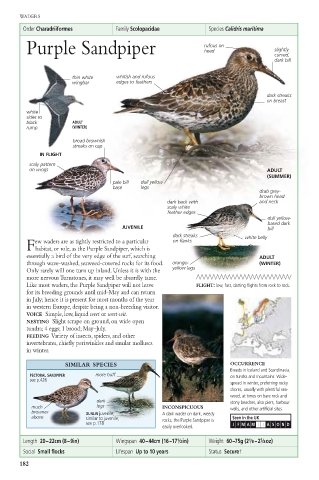
        Purple Sandpiper                            rufous on        slightly
                                                    head
                                                                     curved,
                                                                     dark bill
                   thin white  whitish and rufous
                   wingbar    edges to feathers
                                                                   dark streaks
                                                                   on breast
        white
        sides to
        black      ADULT
        rump       (WINTER)
                   broad brownish
                   streaks on cap
           IN FLIGHT
        scaly pattern
        on wings                                                   ADULT
                                                                   (SUMMER)
                             pale bill  dull yellow
                             base   legs
                                                                 drab grey-
                                                                 brown head
                                           dark back with        and neck
                                           scaly white
                                           feather edges
                                                                   dull yellow-
                                                                   based dark
                               JUVENILE                            bill
                                            dark streaks      white belly
          ew waders are as tightly restricted to a particular   on flanks
        Fhabitat, or role, as the Purple Sandpiper, which is
        essentially a bird of the very edge of the surf, searching  ADULT
        through wave-washed, seaweed-covered rocks for its food.  orange-  (WINTER)
        Only rarely will one turn up inland. Unless it is with the  yellow legs
        more nervous Turnstones, it may well be absurdly tame.
        Like most waders, the Purple Sandpiper will not leave   FLIGHT: low, fast, darting flights from rock to rock.
        for its breeding grounds until mid-May and can return
        in July; hence it is present for most months of the year
        in western Europe, despite being a non-breeding visitor.
        VOICE Simple, low, liquid weet or weet-wit.
        NESTING Slight scrape on ground, on wide open
        tundra; 4 eggs; 1 brood; May–July.
        FEEDING Variety of insects, spiders, and other
        invertebrates, chiefly periwinkles and similar molluscs
        in winter.
                 SIMILAR SPECIES                          OCCURRENCE
                                                          Breeds in Iceland and Scandinavia,
        PECTORAL SANDPIPER  more buff                     on tundra and mountains. Wide-
        see p.426
                                                          spread in winter, preferring rocky
                                                          shores, usually with plentiful sea-
                                                          weed, at times on bare rock and
                         dark                             stony beaches, also piers, harbour
         much            legs            INCONSPICUOUS    walls, and other artificial sites.
         browner      DUNLIN juvenile,   A dark wader on dark, weedy
         above        similar to juvenile;  rocks, the Purple Sandpiper is  Seen in the UK
                      see p.178                            J  F  M  A  M  JJ AS O  N  D
                                         easily overlooked.
       Length  20–22cm (8–9in)  Wingspan  40–44cm (16–17 1 ⁄2in)  Weight  60–75g (2 1 ⁄8 –2 5 ⁄8oz)
       Social  Small flocks   Lifespan  Up to 10 years  Status  Secure†
      182

