


Page 189 - Complete Birds of Britain and Europe (DK - RSPB)
P. 189
WADERS
       Order Charadriiformes  Family Scolopacidae    Species Tringa totanus
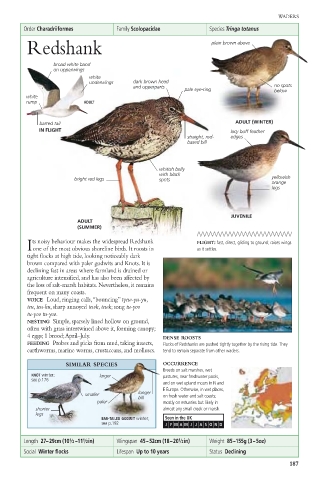
        Redshank                                      plain brown above


              broad white band
              on upperwings
                       white
                       underwings  dark brown head
                                  and upperparts                     no spots
                                               pale eye-ring         below
        white
        rump          ADULT
           barred tail                                     ADULT (WINTER)
           IN FLIGHT                                      lacy buff feather
                                                straight, red-  edges
                                                based bill


                                         whitish belly
                                         with black
                   bright red legs       spots                      yellowish
                                                                    orange
                                                                    legs

                                                          JUVENILE
                    ADULT
                    (SUMMER)
         ts noisy behaviour makes the widespread Redshank  FLIGHT: fast, direct, gliding to ground; raises wings
        Ione of the most obvious shoreline birds. It roosts in  as it settles.
        tight flocks at high tide, looking noticeably dark
        brown compared with paler godwits and Knots. It is
        declining fast in areas where farmland is drained or
        agriculture intensified, and has also been affected by
        the loss of salt-marsh habitats. Nevertheless, it remains
        frequent on many coasts.
        VOICE Loud, ringing calls,“bouncing” tyew-yu-yu,
        teu, teu-hu, sharp annoyed tewk, tewk; song tu-yoo
        tu-yoo tu-yoo.
        NESTING Simple, sparsely lined hollow on ground,
        often with grass intertwined above it, forming canopy;
        4 eggs; 1 brood;April–July.       DENSE ROOSTS
        FEEDING Probes and picks from mud, taking insects,  Flocks of Redshanks are pushed tightly together by the rising tide. They
        earthworms, marine worms, crustaceans, and molluscs.  tend to remain separate from other waders.
                 SIMILAR SPECIES          OCCURRENCE
                                          Breeds on salt marshes, wet
         KNOT winter;     larger          pastures, near freshwater pools,
         see p.176
                                          and on wet upland moors in N and
                                          E Europe. Otherwise, in wet places,
                                   longer
                      smaller             on fresh water and salt coasts;
                                   bill
                         paler            mostly on estuaries but likely in
          shorter                         almost any small creek or marsh.
          legs
                          BAR-TAILED GODWIT winter;  Seen in the UK
                          see p.192       J  F  M  A  M  JJ A S O  N  D
       Length  27–29cm (10 1 ⁄2 –11 1 ⁄2in)  Wingspan  45–52cm (18–20 1 ⁄2in)  Weight  85–155g (3–5oz)
       Social  Winter flocks  Lifespan  Up to 10 years  Status  Declining
                                                                         187

