


Page 201 - Complete Birds of Britain and Europe (DK - RSPB)
P. 201
WADERS
       Order Charadriiformes  Family Scolopacidae    Species Phalaropus lobatus
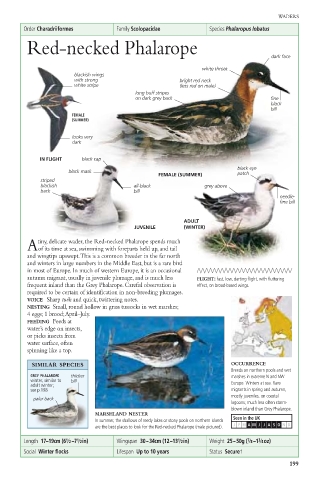
        Red-necked Phalarope
                                                                    dark face
                                                   white throat
                   blackish wings
                   with strong                bright red neck
                   white stripe               (less red on male)
                                   long buff stripes
                                   on dark grey back                fine
                                                                    black
                                                                    bill
                   FEMALE
                   (SUMMER)
                   looks very
                   dark
           IN FLIGHT  black cap
                                                            black eye
                  black mask                                patch
                                        FEMALE (SUMMER)
           striped
           blackish               all-black         grey above
           back                   bill
                                                                       needle-
                                                                       fine bill
                                               ADULT
                                  JUVENILE     (WINTER)
          tiny, delicate wader, the Red-necked Phalarope spends much
        Aof its time at sea, swimming with foreparts held up, and tail
        and wingtips upswept.This is a common breeder in the far north
        and winters in large numbers in the Middle East, but is a rare bird
        in most of Europe. In much of western Europe, it is an occasional
        autumn migrant, usually in juvenile plumage, and is much less  FLIGHT: fast, low, darting flight, with fluttering
        frequent inland than the Grey Phalarope. Careful observation is  effect, on broad-based wings.
        required to be certain of identification in non-breeding plumages.
        VOICE Sharp twik and quick, twittering notes.
        NESTING Small, round hollow in grass tussocks in wet marshes;
        4 eggs; 1 brood;April–July.
        FEEDING Feeds at
        water’s edge on insects,
        or picks insects from
        water surface, often
        spinning like a top.
         SIMILAR SPECIES                                  OCCURRENCE
                                                          Breeds on northern pools and wet
         GREY PHALAROPE  thicker                          marshes in extreme N and NW
         winter, similar to  bill                         Europe. Winters at sea. Rare
         adult winter;
         see p.198                                        migrants in spring and autumn,
                                                          mostly juveniles, on coastal
         paler back
                                                          lagoons; much less often storm-
                                                          blown inland than Grey Phalarope.
                         MARSHLAND NESTER
                         In summer, the shallows of reedy lakes or stony pools on northern islands  Seen in the UK
                         are the best places to look for the Red-necked Phalarope (male pictured).  J  F  M  A  M  JJ A S O  N  D
       Length  17–19cm (6 1 ⁄2 –7 1 ⁄2in)  Wingspan  30–34cm (12–13 1 ⁄2in)  Weight  25–50g ( 7 ⁄8 –1 3 ⁄4oz)
       Social  Winter flocks  Lifespan  Up to 10 years  Status  Secure†
                                                                         199

