


Page 202 - Complete Birds of Britain and Europe (DK - RSPB)
P. 202
WADERS
       Order Charadriiformes  Family Scolopacidae    Species Philomachus pugnax
                                                                 head often
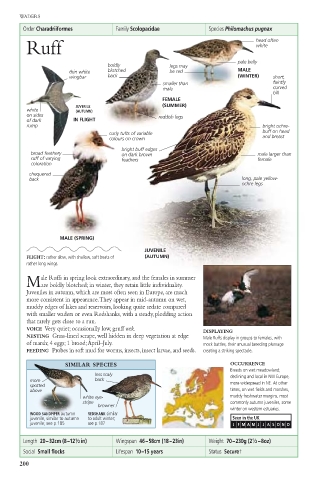
        Ruff                                                     white
                                                            pale belly
                            boldly         legs may
                  thin white  blotched     be red           MALE
                  wingbar   back                            (WINTER)  short,
                                         smaller than                faintly
                                         male                        curved
                                                                     bill
                                         FEMALE
                    JUVENILE             (SUMMER)
        white       (AUTUMN)
        on sides                        reddish legs
        of dark    IN FLIGHT
        rump                                                      bright ochre-
                                                                  buff on head
                            curly tufts of variable
                            colours on crown                      and breast
                               bright buff edges
         broad feathery        on dark brown                     male larger than
         ruff of varying       feathers                          female
         coloration
        chequered
        back                                                 long, pale yellow-
                                                             ochre legs


                MALE (SPRING)
                                     JUVENILE
        FLIGHT: rather slow, with shallow, soft beats of  (AUTUMN)
        rather long wings.
           ale Ruffs in spring look extraordinary, and the females in summer
        Mare boldly blotched; in winter, they retain little individuality.
        Juveniles in autumn, which are most often seen in Europe, are much
        more consistent in appearance.They appear in mid-autumn on wet,
        muddy edges of lakes and reservoirs, looking quite sedate compared
        with smaller waders or even Redshanks, with a steady, plodding action
        that rarely gets close to a run.
        VOICE Very quiet; occasionally low, gruff wek.  DISPLAYING
        NESTING Grass-lined scrape, well hidden in deep vegetation at edge   Male Ruffs display in groups to females, with
        of marsh; 4 eggs; 1 brood;April–July.      mock battles, their unusual breeding plumage
        FEEDING Probes in soft mud for worms, insects, insect larvae, and seeds.  creating a striking spectacle.
                 SIMILAR SPECIES                          OCCURRENCE
                                                          Breeds on wet meadowland;
                         less scaly                       declining and local in NW Europe,
        more             back                             more widespread in NE. At other
        spotted
        above                                             times, on wet fields and marshes,
                      white eye-                          muddy freshwater margins, most
                      stripe                              commonly autumn juveniles, some
                         browner
                                                          winter on western estuaries.
        WOOD SANDPIPER autumn  REDSHANK similar
        juvenile, similar to autumn  to adult winter;      Seen in the UK
        juvenile; see p.185  see p.187                     J  F  M  A  M  JJ A S O  N  D
       Length  20–32cm (8–12 1 ⁄2 in)  Wingspan  46–58cm (18–23in)  Weight  70–230g (2 1 ⁄2 –8oz)
       Social  Small flocks   Lifespan  10–15 years  Status  Secure†
      200

