


Page 197 - Complete Birds of Britain and Europe (DK - RSPB)
P. 197
WADERS
       Order Charadriiformes  Family Scolopacidae    Species Scolopax rusticola
        Woodcock

                                                              bold black
                                                              bars on back
                                                  eyes set far  of head
                                dead-leaf pattern  back on head
                                on upperparts                        angular
                       broad                                         head
                       wings
                                                                     long,
                                                                     straight,
                                                                     thick-
                                                                     based
                    bill
            IN FLIGHT                                                bill
                    angled
                    down
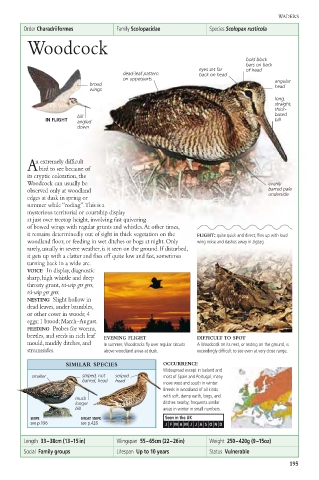
          n extremely difficult
        A bird to see because of
        its cryptic coloration, the
        Woodcock can usually be                                     evenly
        observed only at woodland                                   barred pale
                                                                    underside
        edges at dusk in spring or
        summer while “roding”.This is a
        mysterious territorial or courtship display
        at just over treetop height, involving fast quivering
        of bowed wings with regular grunts and whistles.At other times,
        it remains determinedly out of sight in thick vegetation on the  FLIGHT: quite quick and direct; flies up with loud
        woodland floor, or feeding in wet ditches or bogs at night. Only  wing noise and dashes away in zigzag.
        rarely, usually in severe weather, is it seen on the ground. If disturbed,
        it gets up with a clatter and flies off quite low and fast, sometimes
        turning back in a wide arc.
        VOICE In display, diagnostic
        sharp, high whistle and deep
        throaty grunt, tsi-wip grr grrr,
        tsi-wip grr grrr.
        NESTING Slight hollow in
        dead leaves, under brambles,
        or other cover in woods; 4
        eggs; 1 brood; March–August.
        FEEDING Probes for worms,
        beetles, and seeds in rich leaf  EVENING FLIGHT  DIFFICULT TO SPOT
        mould, muddy ditches, and  In summer, Woodcocks fly over regular circuits  A Woodcock on its nest, or resting on the ground, is
        streamsides.       above woodland areas at dusk.  exceedingly difficult to see even at very close range.
                 SIMILAR SPECIES          OCCURRENCE
                                          Widespread except in Iceland and
         smaller     striped, not  striped  most of Spain and Portugal; many
                     barred, head  head
                                          move west and south in winter.
                                          Breeds in woodland of all kinds
                                          with soft, damp earth, bogs, and
                    much
                    longer                ditches nearby; frequents similar
                    bill                  areas in winter in small numbers.
         SNIPE       GREAT SNIPE          Seen in the UK
         see p.196   see p.428            J  F  M  A  M  JJ A S O  N  D
       Length  33–38cm (13–15 in)  Wingspan  55–65cm (22–26in)  Weight  250–420g (9–15oz)
       Social  Family groups  Lifespan  Up to 10 years  Status  Vulnerable
                                                                         195

