


Page 203 - Complete Birds of Britain and Europe (DK - RSPB)
P. 203
SKUAS, GULLS,AND TERNS/AUKS
        Families Stercorariidae, Laridae, Sternidae
        SKUAS, GULLS, AND TERNS

            OST OF THESE WATER birds live at sea but  but many remain on the coast.They forage in
        M others are freshwater species for part or   flocks,and the larger species are fiercely predatory.
        all of the year.They swim well and fly expertly:  Sexes are alike but immature plumages are quite
        terns hover and dive, while larger gulls are able  different from the adults: the larger species take
        to soar in upcurrents or a good breeze.Gulls walk four years to gain adult colours.
        easily but skuas, and especially the short-legged
        terns, are not nearly so agile on the ground. All  TERNS
        defend their nests boldly, some terns and all the  Mostly smaller than gulls, and longer-tailed,
        skuas quite likely to strike human intruders on  terns are long-distance migrants. Some have
        the head if they approach too closely.  black caps in summer and these dive from the
                                          air for fish; the “marsh terns” are
        SKUAS                             darker in summer and dip to
        Piratical seabirds, skuas kill their own prey but  pick up food from the
        get most of their food by chasing other seabirds  surface as they fly.
        and forcing them to drop or disgorge it. Some
        species have several plumage forms and their
        immatures are rather different from adults.

        GULLS
        While the Kittiwake is a maritime gull,
        others breed inland or move inland
        in winter to some extent,
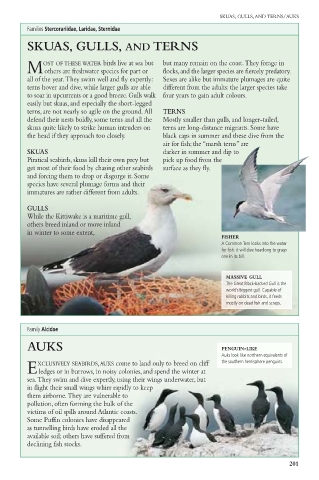
                                                        FISHER
                                                        A Common Tern looks into the water
                                                        for fish: it will dive headlong to grasp
                                                        one in its bill.

                                                         MASSIVE GULL
                                                         The Great Black-backed Gull is the
                                                         world’s biggest gull. Capable of
                                                         killing rabbits and birds, it feeds
                                                         mostly on dead fish and scraps.


        Family Alcidae
        AUKS                                            PENGUIN-LIKE
                                                        Auks look like northern equivalents of
          XCLUSIVELY SEABIRDS,AUKS come to land only to breed on cliff  the southern hemisphere penguins.
        E ledges or in burrows, in noisy colonies, and spend the winter at
        sea.They swim and dive expertly, using their wings underwater, but
        in flight their small wings whirr rapidly to keep
        them airborne.They are vulnerable to
        pollution, often forming the bulk of the
        victims of oil spills around Atlantic coasts.
        Some Puffin colonies have disappeared
        as tunnelling birds have eroded all the
        available soil; others have suffered from
        declining fish stocks.


                                                                         201

