


Page 204 - Complete Birds of Britain and Europe (DK - RSPB)
P. 204
SKUAS, GULLS,AND TERNS
       Order Charadriiformes  Family Stercorariidae  Species Stercorarius skua
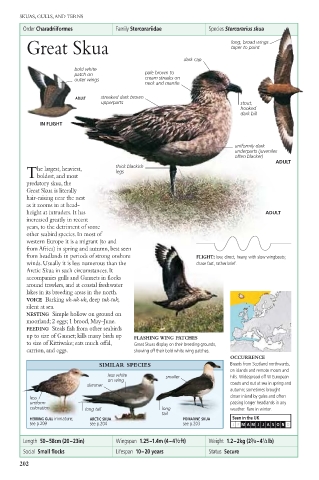
        Great Skua                                        long, broad wings
                                                          taper to point
                                               dark cap
                    bold white
                    patch on         pale brown to
                    outer wings      cream streaks on
                                     neck and mantle
                    ADULT  streaked dark brown
                          upperparts                         stout,
                                                             hooked
                                                             dark bill
           IN FLIGHT

                                                           uniformly dark
                                                           underparts (juveniles
                                                           often blacker)
                                                                     ADULT
          he largest, heaviest,  thick blackish
                              legs
        Tboldest, and most
        predatory skua, the
        Great Skua is literally
        hair-raising near the nest
        as it zooms in at head-
        height at intruders. It has                                ADULT
        increased greatly in recent
        years, to the detriment of some
        other seabird species. In most of
        western Europe it is a migrant (to and
        from Africa) in spring and autumn, best seen
        from headlands in periods of strong onshore  FLIGHT: low, direct, heavy, with slow wingbeats;
        winds. Usually it is less numerous than the  chase fast, rather brief.
        Arctic Skua in such circumstances. It
        accompanies gulls and Gannets in flocks
        around trawlers, and at coastal freshwater
        lakes in its breeding areas in the north.
        VOICE Barking uk-uk-uk, deep tuk-tuk;
        silent at sea.
        NESTING Simple hollow on ground on
        moorland; 2 eggs; 1 brood, May–June.
        FEEDING Steals fish from other seabirds
        up to size of Gannet; kills many birds up   FLASHING WING PATCHES
        to size of Kittiwake; eats much offal,  Great Skuas display on their breeding grounds,
        carrion, and eggs.        showing off their bold white wing patches.
                                                          OCCURRENCE
                          SIMILAR SPECIES                 Breeds from Scotland northwards,
                                                          on islands and remote moors and
                            less white    smaller         hills. Widespread off W European
                            on wing
                       slimmer                            coasts and out at sea in spring and
                                                          autumn; sometimes brought
                                                          closer inland by gales and often
        less
        uniform                                           passing longer headlands in any
        coloration    long tail          long             weather. Rare in winter.
                                         tail
        HERRING GULL immature;  ARCTIC SKUA   POMARINE SKUA  Seen in the UK
        see p.209      see p.204              see p.203    J  F  M  A  M  JJ A S O  N  D
       Length  50–58cm (20–23in)  Wingspan  1.25–1.4m (4–4 1 ⁄2ft)  Weight  1.2–2kg (2 3 ⁄4 –4 1 ⁄2lb)
       Social  Small flocks   Lifespan  10–20 years  Status  Secure
      202

