


Page 199 - Complete Birds of Britain and Europe (DK - RSPB)
P. 199
WADERS
       Order Charadriiformes  Family Scolopacidae    Species Lymnocryptes minimus
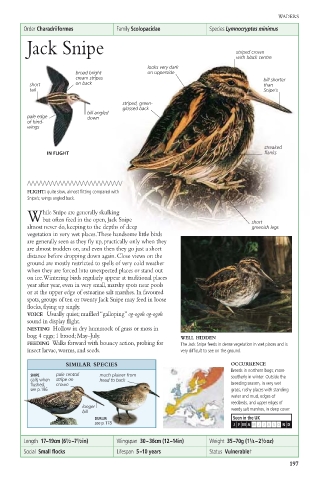
        Jack Snipe                                          striped crown

                                                            with black centre
                                      looks very dark
                    broad bright      on upperside
                    cream stripes                                 bill shorter
        short       on back                                       than
        tail                                                      Snipe’s
                               striped, green-
                               glossed back
                       bill angled
        pale edge      down
        of hind-
        wings
                                                                   streaked
             IN FLIGHT                                             flanks


        FLIGHT: quite slow, almost flitting compared with
        Snipe’s; wings angled back.
            hile Snipe are generally skulking
        Wbut often feed in the open, Jack Snipe                 short
        almost never do, keeping to the depths of deep          greenish legs
        vegetation in very wet places.These handsome little birds
        are generally seen as they fly up, practically only when they
        are almost trodden on, and even then they go just a short
        distance before dropping down again. Close views on the
        ground are mostly restricted to spells of very cold weather
        when they are forced into unexpected places or stand out
        on ice.Wintering birds regularly appear at traditional places
        year after year, even in very small, marshy spots near pools
        or at the upper edge of estuarine salt marshes. In favoured
        spots, groups of ten or twenty Jack Snipe may feed in loose
        flocks, flying up singly.
        VOICE Usually quiet; muffled “galloping” og-ogok og-ogok
        sound in display flight.
        NESTING Hollow in dry hummock of grass or moss in
        bog; 4 eggs; 1 brood; May–July.       WELL HIDDEN
        FEEDING Walks forward with bouncy action, probing for  The Jack Snipe feeds in dense vegetation in wet places and is
        insect larvae, worms, and seeds.      very difficult to see on the ground.
                 SIMILAR SPECIES                          OCCURRENCE
                                                          Breeds in northern bogs; more
         SNIPE  pale central  much plainer from           southerly in winter. Outside the
         calls when  stripe on  head to back
         flushed;  crown                                  breeding season, in very wet
         see p.196                                        grass, rushy places with standing
                                                          water and mud, edges of
                                                          reedbeds, and upper edges of
                     longer                               weedy salt marshes, in deep cover.
                     bill
                         DUNLIN                            Seen in the UK
                         see p.178                         JF M A  M J  JA S O N D
       Length  17–19cm (6 1 ⁄2 –7 1 ⁄2in)  Wingspan  30–36cm (12–14in)  Weight  35–70g (1 1 ⁄4 –2 1 ⁄2oz)
       Social  Small flocks   Lifespan  5–10 years   Status  Vulnerable†
                                                                         197

