


Page 208 - Complete Birds of Britain and Europe (DK - RSPB)
P. 208
SKUAS, GULLS,AND TERNS
       Order Charadriiformes  Family Laridae         Species Larus ridibundus
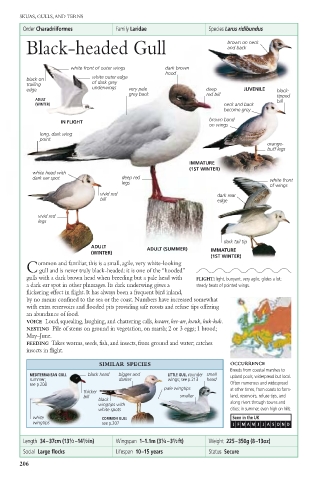
        Black-headed Gull                                brown on neck
                                                         and back

                   white front of outer wings  dark brown
                                          hood
                        white outer edge
        black on
        trailing        of dark grey
        edge            underwings  very pale       deep      JUVENILE  black-
                                 grey back          red bill          tipped
          ADULT                                                       bill
          (WINTER)                                       neck and back
                                                         become grey
                                                     brown band
                IN FLIGHT
                                                     on wings
           long, dark wing
           point
                                                                   orange-
                                                                   buff legs
                                                IMMATURE
                                                (1ST WINTER)
         white head with
         dark ear spot         deep red                             white front
                               legs
                                                                    of wings
                          vivid red                    dark rear
                          bill                         edge
           vivid red
           legs
                                                         dark tail tip
                        ADULT        ADULT (SUMMER)
                        (WINTER)                     IMMATURE
                                                     (1ST WINTER)
          ommon and familiar, this is a small, agile, very white-looking
        C gull and is never truly black-headed: it is one of the “hooded”
        gulls with a dark brown head when breeding but a pale head with   FLIGHT: light, buoyant, very agile; glides a lot;
        a dark ear spot in other plumages. Its dark underwing gives a  steady beats of pointed wings.
        flickering effect in flight. It has always been a frequent bird inland,
        by no means confined to the sea or the coast. Numbers have increased somewhat
        with extra reservoirs and flooded pits providing safe roosts and refuse tips offering
        an abundance of food.
        VOICE Loud, squealing, laughing, and chattering calls, kwarrr, kee-arr, kwuk, kuk-kuk.
        NESTING Pile of stems on ground in vegetation, on marsh; 2 or 3 eggs; 1 brood;
        May–June.
        FEEDING Takes worms, seeds, fish, and insects, from ground and water; catches
        insects in flight.
                          SIMILAR SPECIES                 OCCURRENCE
                                                          Breeds from coastal marshes to
        MEDITERRANEAN GULL  black head   bigger and  LITTLE GULL rounder  small  upland pools, widespread but local.
        summer;                darker      wings; see p.213  head
        see p.208                                         Often numerous and widespread
                                          pale wingtips   at other times, from coasts to farm-
                      thicker
                      bill                    smaller     land, reservoirs, refuse tips, and
                         black                            along rivers through towns and
                         wingtips with
                         white spots                      cities; in summer, even high on hills.
         white            COMMON GULL                      Seen in the UK
         wingtips         see p.207                        J  F  M  A  M  JJ A S O  N  D
       Length  34–37cm (13 1 ⁄2 –14 1 ⁄2in)  Wingspan  1–1.1m (3 1 ⁄4 –3 1 ⁄2ft)  Weight  225–350g (8–13oz)
       Social  Large flocks   Lifespan  10–15 years  Status  Secure
      206

