


Page 214 - Complete Birds of Britain and Europe (DK - RSPB)
P. 214
SKUAS, GULLS,AND TERNS
       Order Charadriiformes  Family Laridae         Species Larus marinus
        Great Black-backed Gull                             whitish head
                                                               black bill
            large white patch
            on outer wings  broad wings  faint markings  IMMATURE
                                     on white head  (1ST WINTER)

                 dark flight
                 feathers
                        ADULT (SUMMER)                                 pale
                                                      large yellow bill  head
                           black back                 with red spot
              ADULT
              (WINTER)
              IN FLIGHT

                                                                 IMMATURE
                                                   chequered back
                                                                 (2ND WINTER)
                                                 white
                                                 underside
                                                              white head
                                           pale greyish,
                       ADULT               whitish, or
                       (WINTER)            pink legs

        FLIGHT: strong but heavy, with slow, deep,
        sweeping wingbeats.                             ADULT
                                                        (SUMMER)
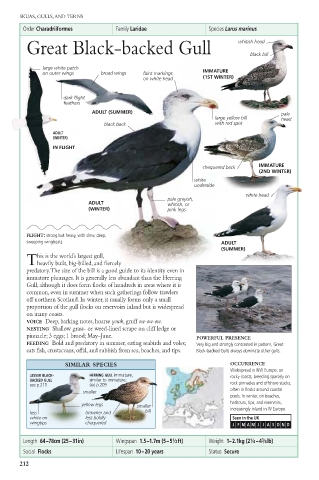
          his is the world’s largest gull,
        Theavily built, big-billed, and fiercely
        predatory.The size of the bill is a good guide to its identity even in
        immature plumages. It is generally less abundant than the Herring
        Gull, although it does form flocks of hundreds in areas where it is
        common, even in summer when such gatherings follow trawlers
        off northern Scotland. In winter, it usually forms only a small
        proportion of the gull flocks on reservoirs inland but is widespread
        on many coasts.
        VOICE Deep, barking notes, hoarse yowk, gruff ow-ow-ow.
        NESTING Shallow grass- or weed-lined scrape on cliff ledge or
        pinnacle; 3 eggs; 1 brood; May–June.      POWERFUL PRESENCE
        FEEDING Bold and predatory in summer, eating seabirds and voles;  Very big and strongly contrasted in pattern, Great
        eats fish, crustaceans, offal, and rubbish from sea, beaches, and tips.  Black-backed Gulls always dominate other gulls.
                 SIMILAR SPECIES                          OCCURRENCE
                                                          Widespread in NW Europe, on
        LESSER BLACK-  HERRING GULL immature,             rocky coasts, breeding sparsely on
        BACKED GULL    similar to immature;               rock pinnacles and offshore stacks,
        see p.211      see p.209
                                                          often in flocks around coastal
                      smaller
                                                          pools. In winter, on beaches,
                                                          harbours, tips, and reservoirs,
                     yellow legs   smaller
        less          browner and    bill                 increasingly inland in W Europe.
        white on      less boldly                          Seen in the UK
        wingtips      chequered                            J  F  M  A  M  JJ A S O  N  D
       Length  64–78cm (25–31in)  Wingspan  1.5–1.7m (5–5 1 ⁄2ft)  Weight  1–2.1kg (2 1 ⁄4 –4 3 ⁄4lb)
       Social  Flocks         Lifespan  10–20 years  Status  Secure
      212

