


Page 215 - Complete Birds of Britain and Europe (DK - RSPB)
P. 215
SKUAS, GULLS,AND TERNS
       Order Charadriiformes  Family Laridae         Species Larus minutus
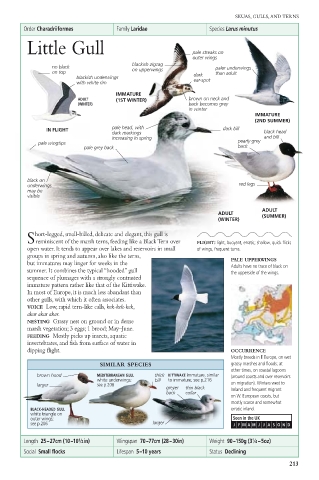
        Little Gull                              pale streaks on

                                                 outer wings
                                  blackish zigzag
              no black                                 paler underwings
              on top              on upperwings  dark  than adult
                    blackish underwings
                    with white rim               ear-spot
                              IMMATURE
                    ADULT     (1ST WINTER)      brown on neck and
                    (WINTER)                    back becomes grey
                                                in winter
                                                                IMMATURE
                                                                (2ND SUMMER)
             IN FLIGHT       pale head, with            dark bill
                             dark markings                         black head
                             increasing in spring                  and bill
          pale wingtips                                     pearly grey
                      pale grey back                        back

        black on
        underwings                                          red legs
        may be
        visible
                                                                  ADULT
                                                       ADULT      (SUMMER)
                                                       (WINTER)
          hort-legged, small-billed, delicate and elegant, this gull is
        Sreminiscent of the marsh terns, feeding like a Black Tern over  FLIGHT: light, buoyant, erratic; shallow, quick flicks
        open water. It tends to appear over lakes and reservoirs in small  of wings, frequent turns.
        groups in spring and autumn, also like the terns,
        but immatures may linger for weeks in the         PALE UPPERWINGS
                                                          Adults have no trace of black on
        summer. It combines the typical “hooded” gull     the upperside of the wings.
        sequence of plumages with a strongly contrasted
        immature pattern rather like that of the Kittiwake.
        In most of Europe, it is much less abundant than
        other gulls, with which it often associates.
        VOICE Low, rapid tern-like calls, kek-kek-kek,
        akar akar akar.
        NESTING Grassy nest on ground or in dense
        marsh vegetation; 3 eggs; 1 brood; May–June.
        FEEDING Mostly picks up insects, aquatic
        invertebrates, and fish from surface of water in
        dipping flight.                                   OCCURRENCE
                                                          Mostly breeds in E Europe, on wet
                          SIMILAR SPECIES                 grassy marshes and floods; at
                                                          other times, on coastal lagoons
          brown hood     MEDITERRANEAN GULL  thick  KITTIWAKE immature, similar  (around coasts and over reservoirs
                         white underwings;   bill  to immature; see p.216
          larger         see p.208                        on migration). Winters west to
                                          greyer  thin black  Ireland and frequent migrant
                                          back  collar
                                                          on W. European coasts, but
                                                          mostly scarce and somewhat
         BLACK-HEADED GULL                                erratic inland.
         white triangle on
         outer wings;                                      Seen in the UK
         see p.206                     larger              J  F  M  A  M  JJ A S O  N  D
       Length  25–27cm (10–10 1 ⁄2in)  Wingspan  70–77cm (28–30in)  Weight  90–150g (3 1 ⁄4 –5oz)
       Social  Small flocks   Lifespan  5–10 years   Status  Declining
                                                                         213

