


Page 238 - Complete Birds of Britain and Europe (DK - RSPB)
P. 238
PIGEONS AND DOVES
       Order Columbiformes    Family Columbidae      Species Streptopelia turtur
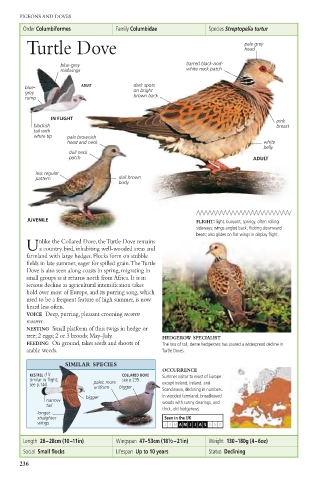
        Turtle Dove                                           pale grey
                                                              head

                blue-grey                      barred black-and-
                midwings                       white neck patch
       blue-         ADULT        dark spots
       grey                       on bright
       rump                       brown back

              IN FLIGHT
                                                                      pink
         blackish                                                     breast
         tail with
         white tip  pale brownish
                  head and neck                                   white
                                                                  belly
                  dull neck
                  patch                                         ADULT
          less regular
          pattern              dull brown
                               body


        JUVENILE                                  FLIGHT: light, buoyant, springy, often rolling
                                                  sideways; wings angled back, flicking downward
                                                  beats; also glides on flat wings in display flight.
           nlike the Collared Dove, the Turtle Dove remains
        Ua country bird, inhabiting well-wooded areas and
        farmland with large hedges. Flocks form on stubble
        fields in late summer, eager for spilled grain.The Turtle
        Dove is also seen along coasts in spring, migrating in
        small groups as it returns north from Africa. It is in
        serious decline as agricultural intensification takes
        hold over most of Europe, and its purring song, which
        used to be a frequent feature of high summer, is now
        heard less often.
        VOICE Deep, purring, pleasant crooning rooorrrr
        rooorrrr.
        NESTING Small platform of thin twigs in hedge or
        tree; 2 eggs; 2 or 3 broods; May–July.  HEDGEROW SPECIALIST
        FEEDING On ground, takes seeds and shoots of   The loss of tall, dense hedgerows has caused a widespread decline in
        arable weeds.                    Turtle Doves.
                 SIMILAR SPECIES
                                         OCCURRENCE
        KESTREL 32             COLLARED DOVE  Summer visitor to most of Europe
        similar in flight;  paler, more  see p.235
        see p.140                        except Iceland, Ireland, and
                        uniform  bigger
                                         Scandinavia, declining in numbers.
                      bigger             In wooded farmland, broadleaved
             narrow                      woods with sunny clearings, and
             tail
                                         thick, old hedgerows.
          longer,
          straighter                      Seen in the UK
          wings                           J  F  M  A  M  JJ A S O  N  D
       Length  26–28cm (10–11in)  Wingspan  47–53cm (18 1 ⁄2 –21in)  Weight  130–180g (4–6oz)
       Social  Small flocks   Lifespan  Up to 10 years  Status  Declining
      236

