


Page 250 - Complete Birds of Britain and Europe (DK - RSPB)
P. 250
SWIFTS
        Family Apodidae
        SWIFTS

           O BIRDS ARE MORE specialized than the
        N swifts.They have tiny bills but large, broad
        mouths, in which they catch flying insects.Their
        tapered bodies and long, stiff, scythe-shaped
        wings are aerodynamically ideal for sustained
        flight.They have a good turn of speed when
        displaying, but generally feed at a much slower
        pace, gliding efficiently and turning dextrously
        to catch their small prey.
         Their feet are minute, with all four toes
        pointing forwards, just enough to cling to
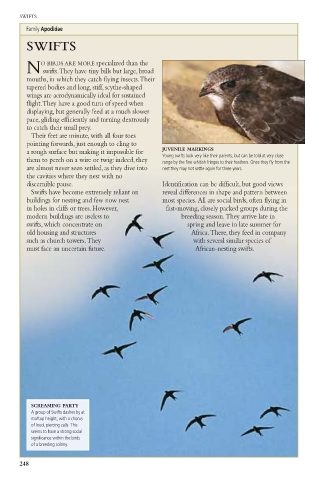
        a rough surface but making it impossible for  JUVENILE MARKINGS
                                         Young swifts look very like their parents, but can be told at very close
        them to perch on a wire or twig: indeed, they  range by the fine whitish fringes to their feathers. Once they fly from the
        are almost never seen settled, as they dive into  nest they may not settle again for three years.
        the cavities where they nest with no
        discernible pause.               Identification can be difficult, but good views
         Swifts have become extremely reliant on  reveal differences in shape and pattern between
        buildings for nesting and few now nest  most species. All are social birds, often flying in
        in holes in cliffs or trees. However,  fast-moving, closely packed groups during the
        modern buildings are useless to       breeding season.They arrive late in
        swifts, which concentrate on            spring and leave in late summer for
        old housing and structures               Africa.There, they feed in company
        such as church towers.They               with several similar species of
        must face an uncertain future.            African-nesting swifts.


         SCREAMING PARTY
         A group of Swifts dashes by at
         rooftop height, with a chorus
         of loud, piercing calls. This
         seems to have a strong social
         significance within the birds
         of a breeding colony.

      248

