


Page 247 - Complete Birds of Britain and Europe (DK - RSPB)
P. 247
OWLS
       Order Strigiformes     Family Strigidae       Species Otus scops
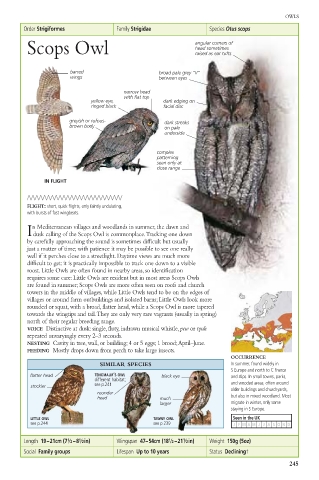
        Scops Owl                                angular corners of
                                                 head sometimes
                                                 raised as ear tufts

                  barred                broad pale grey “V”
                  wings                 between eyes
                                narrow head
                                with flat top
                        yellow eye,       dark edging on
                        ringed black      facial disc
                  greyish or rufous-      dark streaks
                  brown body              on pale
                                          underside

                                        complex
                                        patterning
                                        seen only at
                                        close range
            IN FLIGHT


        FLIGHT: short, quick flights, only faintly undulating,
        with bursts of fast wingbeats.
         n Mediterranean villages and woodlands in summer, the dawn and
        Idusk calling of the Scops Owl is commonplace.Tracking one down
        by carefully approaching the sound is sometimes difficult but usually
        just a matter of time; with patience it may be possible to see one really
        well if it perches close to a streetlight. Daytime views are much more
        difficult to get: it is practically impossible to track one down to a visible
        roost. Little Owls are often found in nearby areas, so identification
        requires some care: Little Owls are resident but in most areas Scops Owls
        are found in summer; Scops Owls are more often seen on roofs and church
        towers in the middle of villages, while Little Owls tend to be on the edges of
        villages or around farm outbuildings and isolated barns; Little Owls look more
        rounded or squat, with a broad, flatter head, while a Scops Owl is more tapered
        towards the wingtips and tail.They are only very rare vagrants (usually in spring)
        north of their regular breeding range.
        VOICE Distinctive at dusk: single, fluty, indrawn musical whistle, pew or tyuh
        repeated unvaryingly every 2–3 seconds.
        NESTING Cavity in tree, wall, or building; 4 or 5 eggs; 1 brood;April–June.
        FEEDING Mostly drops down from perch to take large insects.
                                                          OCCURRENCE
                          SIMILAR SPECIES                 In summer, found widely in
                                                          S Europe and north to C France
         flatter head    TENGMALM’S OWL  black eye        and Alps. In small towns, parks,
                         different habitat;
         stockier        see p.241                        and wooded areas, often around
                                                          older buildings and churchyards,
                         rounder
                         head            much             but also in mixed woodland. Most
                                         larger           migrate in winter, only some
                                                          staying in S Europe.
         LITTLE OWL                    TAWNY OWL           Seen in the UK
         see p.244                     see p.239           JF M A  M J  JA S ON D
       Length  19–21cm (7 1 ⁄2 –8 1 ⁄2in)  Wingspan  47–54cm (18 1 ⁄2 –21 1 ⁄2in)  Weight  150g (5oz)
       Social  Family groups  Lifespan  Up to 10 years  Status  Declining†
                                                                         245

