


Page 245 - Complete Birds of Britain and Europe (DK - RSPB)
P. 245
OWLS
       Order Strigiformes     Family Strigidae       Species Asio flammeus
        Short-eared Owl
                                                 large, round head
                                                 with tiny tufts
                  dark wingtips                  usually hidden
                                  whitish underwings
                  row of pale     with narrow dark
                  spots along     bar at angle  blackish ring
                  sides of back                 around large,
                                                cold yellow eye

                                          complex buff
                                          marbling on
                   dark wrist             upperparts
                   patch
        white               white
        trailing   orange-buff  belly
        edge       to yellowish
                   outer wings
             IN FLIGHT
                                                                   buff-white
                                                                   underside
                                                                   with fine
        FLIGHT: low, wavering, quite quick, with slow              dark streaks
        beats of stiff wings, quite high upstroke; floating,
        banking glides.
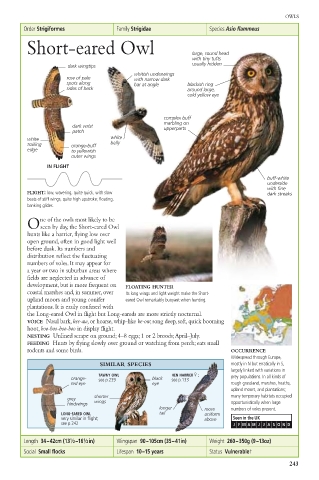
           ne of the owls most likely to be
        Oseen by day, the Short-eared Owl
        hunts like a harrier, flying low over
        open ground, often in good light well
        before dusk. Its numbers and
        distribution reflect the fluctuating
        numbers of voles. It may appear for
        a year or two in suburban areas where
        fields are neglected in advance of
        development, but is more frequent on  FLOATING HUNTER
        coastal marshes and, in summer, over  Its long wings and light weight make the Short-
        upland moors and young conifer  eared Owl remarkably buoyant when hunting.
        plantations. It is easily confused with
        the Long-eared Owl in flight but Long-eareds are more strictly nocturnal.
        VOICE Nasal bark,kee-aw,or hoarse,whip-like ke-ow;song deep,soft,quick booming
        hoot, boo-boo-boo-boo in display flight.
        NESTING Unlined scrape on ground; 4–8 eggs; 1 or 2 broods;April–July.
        FEEDING Hunts by flying slowly over ground or watching from perch; eats small
        rodents and some birds.                           OCCURRENCE
                                                          Widespread through Europe,
                          SIMILAR SPECIES                 mostly in N but erratically in S,
                                                          largely linked with variations in
                          TAWNY OWL         HEN HARRIER 2;  prey populations. In all kinds of
                   orange-  see p.239  black  see p.133
                   red eye             eye                rough grassland, marshes, heaths,
                                                          upland moors, and plantations;
                        shorter                           many temporary habitats occupied
                  grey  wings
                  hindwings                               opportunistically when large
                                         longer     more  numbers of voles present.
                LONG-EARED OWL           tail       uniform
                very similar in flight;             above  Seen in the UK
                see p.242                                  J  F  M  A  M  JJ A S O  N  D
       Length  34–42cm (13 1 ⁄2–16 1 ⁄2in)  Wingspan  90–105cm (35–41in)  Weight  260–350g (9–13oz)
       Social  Small flocks   Lifespan  10–15 years  Status  Vulnerable†
                                                                         243

