


Page 248 - Complete Birds of Britain and Europe (DK - RSPB)
P. 248
OWLS
       Order Strigiformes     Family Tytonidae       Species Tyto alba
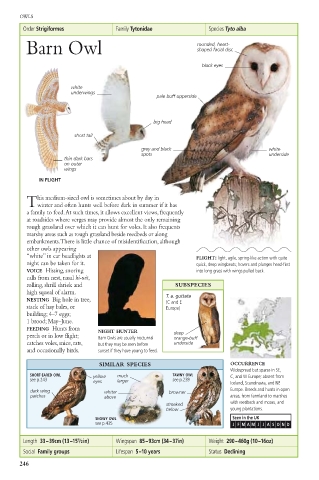
        Barn Owl                                  rounded, heart-
                                                  shaped facial disc

                                                   black eyes

                   white
                   underwings
                                        pale buff upperside

                                       big head

                    short tail
                                    grey and black                  white
                                    spots                           underside
                 thin dark bars
                 on outer
                 wings
           IN FLIGHT
          his medium-sized owl is sometimes about by day in
        Twinter and often hunts well before dark in summer if it has
        a family to feed.At such times, it allows excellent views, frequently
        at roadsides where verges may provide almost the only remaining
        rough grassland over which it can hunt for voles. It also frequents
        marshy areas such as rough grassland beside reedbeds or along
        embankments.There is little chance of misidentification, although
        other owls appearing
        “white” in car headlights at              FLIGHT: light, agile, spring-like action with quite
        night can be taken for it.                quick, deep wingbeats; hovers and plunges head-first
        VOICE Hissing, snoring                    into long grass with wings pulled back.
        calls from nest, nasal hi-wit,
        rolling, shrill shriek and           SUBSPECIES
        high squeal of alarm.             T. a. guttata
        NESTING Big hole in tree,         (C and E
        stack of hay bales, or            Europe)
        building; 4–7 eggs;
        1 brood; May–June.
        FEEDING Hunts from  NIGHT HUNTER
        perch or in low flight;  Barn Owls are usually nocturnal  deep
                                            orange-buff
        catches voles, mice, rats,  but they may be seen before  underside
        and occasionally birds.  sunset if they have young to feed.
                          SIMILAR SPECIES                 OCCURRENCE
                                                          Widespread but sparse in SE,
        SHORT-EARED OWL  yellow  much       TAWNY OWL     C, and W Europe; absent from
        see p.243       eyes  larger        see p.239     Iceland, Scandinavia, and NE
         dark wing         whiter          browner        Europe. Breeds and hunts in open
         patches           above                          areas, from farmland to marshes
                                                          with reedbeds and moors, and
                                          streaked
                                          below           young plantations.
                         SNOWY OWL                         Seen in the UK
                         see p.435                         J  F  M  A  M  JJ A S O  N  D
       Length  33–39cm (13–15 1 ⁄2in)  Wingspan  85–93cm (34–37in)  Weight  290–460g (10–16oz)
       Social  Family groups  Lifespan  5–10 years   Status  Declining
      246

