


Page 252 - Complete Birds of Britain and Europe (DK - RSPB)
P. 252
SWIFTS
       Order Apodiformes      Family Apodidae        Species Apus pallidus
        Pallid Swift

                                                 darker brown
                                                 wingtips
                  pale brown diagonal
                  band on upperwings
                   ADULT
                         more mottled than adult
                         with obvious pale
                         feather edges
        wingtips
        darker than
        midwings

                                                                    whitish
           IN FLIGHT                                                chin and
                                                                    throat
                               JUVENILE

                                                               pale mud-brown
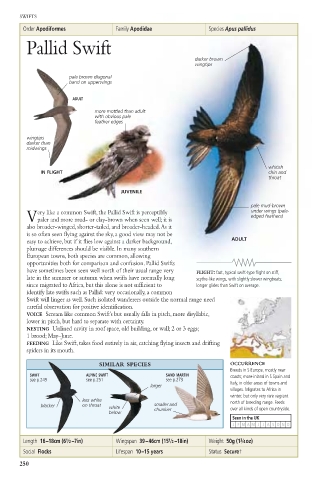
          ery like a common Swift, the Pallid Swift is perceptibly  under wings (pale-
                                                               edged feathers)
        Vpaler and more mud- or clay-brown when seen well; it is
        also broader-winged, shorter-tailed, and broader-headed.As it
        is so often seen flying against the sky, a good view may not be
        easy to achieve, but if it flies low against a darker background,  ADULT
        plumage differences should be visible. In many southern
        European towns, both species are common, allowing
        opportunities both for comparison and confusion. Pallid Swifts
        have sometimes been seen well north of their usual range very  FLIGHT: fast, typical swift-type flight on stiff,
        late in the summer or autumn when swifts have normally long  scythe-like wings, with slightly slower wingbeats;
        since migrated to Africa, but this alone is not sufficient to  longer glides than Swift on average.
        identify late swifts such as Pallid: very occasionally, a common
        Swift will linger as well. Such isolated wanderers outside the normal range need
        careful observation for positive identification.
        VOICE Scream like common Swift’s but usually falls in pitch, more disyllabic,
        lower in pitch, but hard to separate with certainty.
        NESTING Unlined cavity in roof space, old building, or wall; 2 or 3 eggs;
        1 brood; May–June.
        FEEDING Like Swift, takes food entirely in air, catching flying insects and drifting
        spiders in its mouth.
                          SIMILAR SPECIES                 OCCURRENCE
                                                          Breeds in S Europe, mostly near
        SWIFT         ALPINE SWIFT        SAND MARTIN     coasts; more inland in S Spain and
        see p.249     see p.251           see p.273       Italy, in older areas of towns and
                                      larger
                                                          villages. Migrates to Africa in
                                                          winter, but only very rare vagrant
                     less white                           north of breeding range. Feeds
           blacker   on throat  white  smaller and        over all kinds of open countryside.
                            below      chunkier
                                                           Seen in the UK
                                                           JF M A  M J  JA S ON D
       Length  16–18cm (6 1 ⁄2 –7in)  Wingspan  39–46cm (15 1 ⁄2 –18in)  Weight  50g (1 3 ⁄4oz)
       Social  Flocks         Lifespan  10–15 years  Status  Secure†
      250

