


Page 249 - Complete Birds of Britain and Europe (DK - RSPB)
P. 249
NIGHTJARS
       Order Caprimulgiformes  Family Caprimulgidae  Species Caprimulgus europaeus
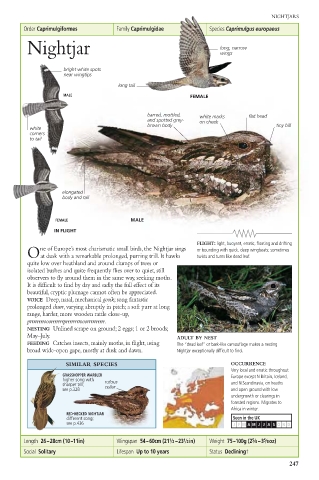
        Nightjar                                        long, narrow
                                                        wings
                 bright white spots
                 near wingtips
                              long tail
                 MALE                           FEMALE


                                      barred, mottled,  white marks  flat head
                                      and spotted grey-  on cheek
                                      brown body                      tiny bill
        white
        corners
        to tail


                 elongated
                 body and tail

               FEMALE            MALE
               IN FLIGHT
                                                  FLIGHT: light, buoyant, erratic, floating and drifting
           ne of Europe’s most charismatic small birds, the Nightjar sings   or bounding with quick, deep wingbeats; sometimes
        Oat dusk with a remarkable prolonged, purring trill. It hawks  twists and turns like dead leaf.
        quite low over heathland and around clumps of trees or
        isolated bushes and quite frequently flies over to quiet, still
        observers to fly around them in the same way, seeking moths.
        It is difficult to find by day and sadly the full effect of its
        beautiful, cryptic plumage cannot often be appreciated.
        VOICE Deep, nasal, mechanical gooik; song fantastic
        prolonged churr, varying abruptly in pitch; a soft purr at long
        range, harder, more wooden rattle close-up,
        prrrrrrrrooorrrrrrrprrrrrrrrooorrrrrrrrrr.
        NESTING Unlined scrape on ground; 2 eggs; 1 or 2 broods;
        May–July.                            ADULT BY NEST
        FEEDING Catches insects, mainly moths, in flight, using  The “dead leaf” or bark-like camouflage makes a nesting
        broad wide-open gape, mostly at dusk and dawn.  Nightjar exceptionally difficult to find.
                 SIMILAR SPECIES                          OCCURRENCE
                                                          Very local and erratic throughout
                 GRASSHOPPER WARBLER                      Europe except N Britain, Iceland,
                 higher song with  rufous
                 sharper trill;   collar                  and N Scandinavia, on heaths
                 see p.328                                and open ground with low
                                                          undergrowth or clearings in
                                                          forested regions. Migrates to
                                                          Africa in winter.
                  RED-NECKED NIGHTJAR
                  different song;                          Seen in the UK
                  see p.436                                J  F  M  A  M  JJ A S O  N  D
       Length  26–28cm (10–11in)  Wingspan  54–60cm (21 1 ⁄2 –23 1 ⁄2in)  Weight  75–100g (2 5 ⁄8 –3 5 ⁄8oz)
       Social  Solitary       Lifespan  Up to 10 years  Status  Declining†
                                                                         247

