


Page 269 - Complete Birds of Britain and Europe (DK - RSPB)
P. 269
LARKS
       Order Passeriformes    Family Alaudidae       Species Galeridae theklae
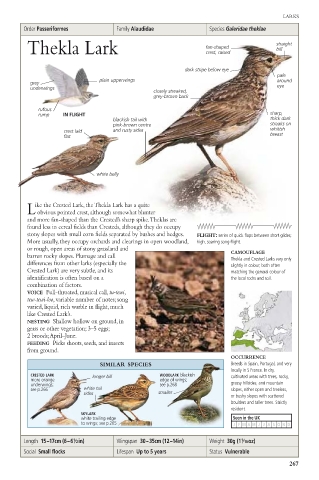
        Thekla Lark                                 fan-shaped        straight
                                                                      bill
                                                    crest, raised
                                               dark stripe below eye
                                                                      pale
                          plain upperwings                            around
         grey
         underwings                                                   eye
                                       closely streaked,
                                       grey-brown back
           rufous
           rump  IN FLIGHT                                          sharp,
                             blackish tail with                     thick dark
                             pink-brown centre                      streaks on
                 crest laid  and rusty sides                        whitish
                 flat                                               breast


                         white belly


          ike the Crested Lark, the Thekla Lark has a quite
        L obvious pointed crest, although somewhat blunter
        and more fan-shaped than the Crested’s sharp spike.Theklas are
        found less in cereal fields than Cresteds, although they do occupy
        stony slopes with small corn fields separated by bushes and hedges.  FLIGHT: series of quick flaps between short glides;
        More usually, they occupy orchards and clearings in open woodland,  high, soaring song-flight.
        or rough, open areas of stony grassland and       CAMOUFLAGE
        barren rocky slopes. Plumage and call             Thekla and Crested Larks vary only
        differences from other larks (especially the      slightly in colour, both often
        Crested Lark) are very subtle, and its            matching the general colour of
        identification is often based on a                the local rocks and soil.
        combination of factors.
        VOICE Full-throated, musical call, tu-tewi,
        tew-tewi-loo, variable number of notes; song
        varied, liquid, rich warble in flight, much
        like Crested Lark’s.
        NESTING Shallow hollow on ground, in
        grass or other vegetation; 3–5 eggs;
        2 broods;April–June.
        FEEDING Picks shoots, seeds, and insects
        from ground.
                                                          OCCURRENCE
                          SIMILAR SPECIES                 Breeds in Spain, Portugal, and very
                                                          locally in S France. In dry,
         CRESTED LARK   longer bill      WOODLARK blackish  cultivated areas with trees, rocky,
         more orange                     edge of wings;
         underwings;                     see p.268        grassy hillsides, and mountain
         see p.266    white tail                          slopes, either open and treeless,
                      sides             smaller
                                                          or bushy slopes with scattered
                                                          boulders and taller trees. Strictly
                                                          resident.
                     SKYLARK
                     white trailing edge                   Seen in the UK
                     to wings; see p.265                   JF M A  M J  JA S ON D
       Length  15–17cm (6–6 1 ⁄2in)  Wingspan  30–35cm (12–14in)  Weight  30g (1 1 ⁄16oz)
       Social  Small flocks   Lifespan  Up to 5 years  Status  Vulnerable
                                                                         267

