


Page 288 - Complete Birds of Britain and Europe (DK - RSPB)
P. 288
PIPITS AND WAGTAILS
       Order Passeriformes    Family Motacillidae    Species Motacilla flava
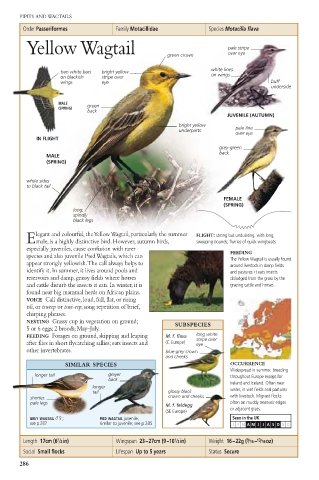
        Yellow Wagtail                                    pale stripe
                                           green crown    over eye

                two white bars  bright yellow        white lines
                on blackish  stripe over             on wings
                wings     eye                                       buff
                                                                    underside
                MALE   green
                (SPRING)
                       back
                                                         JUVENILE (AUTUMN)
                                             bright yellow  pale line
                                             underparts
                                                            over eye
          IN FLIGHT
                                                       grey-green
                                                       back
             MALE
             (SPRING)
        white sides
        to black tail
                                                         FEMALE
                                                         (SPRING)
                   long,
                   spindly
                   black legs
          legant and colourful, the Yellow Wagtail, particularly the summer  FLIGHT: strong but undulating, with long,
        Emale, is a highly distinctive bird. However, autumn birds,  sweeping bounds; flurries of quick wingbeats.
        especially juveniles, cause confusion with rarer
        species and also juvenile Pied Wagtails, which can  FEEDING
                                                          The Yellow Wagtail is usually found
        appear strongly yellowish.The call always helps to  around livestock in damp fields
        identify it. In summer, it lives around pools and  and pastures: it eats insects
        reservoirs and damp, grassy fields where horses   dislodged from the grass by the
        and cattle disturb the insects it eats. In winter, it is  grazing cattle and horses.
        found near big mammal herds on African plains.
        VOICE Call distinctive, loud, full, flat, or rising
        tsli, or tsweep or tswi-eep; song repetition of brief,
        chirping phrases.
        NESTING Grassy cup in vegetation on ground;  SUBSPECIES
        5 or 6 eggs;2 broods;May–July.
        FEEDING Forages on ground, skipping and leaping  M. f. flava  long white
                                                  stripe over
        after flies in short flycatching sallies; eats insects and  (C Europe)  eye
        other invertebrates.              blue-grey crown
                                          and cheeks
                 SIMILAR SPECIES                          OCCURRENCE
                                                          Widespread in summer, breeding
          longer tail       greyer                        throughout Europe except for
                            back
                                                          Ireland and Iceland. Often near
                        longer                            water, in wet fields and pastures
                        tail               glossy black
         shorter,                          crown and cheeks  with livestock. Migrant flocks
         pale legs                                        often on muddy reservoir edges
                                          M. f. feldegg
                                          (SE Europe)     or adjacent grass.
        GREY WAGTAIL 32;  PIED WAGTAIL juvenile,           Seen in the UK
        see p.287         similar to juvenile; see p.285   J  F  M  A  M  JJ A S O  N  D
       Length  17cm (6 1 ⁄2in)  Wingspan  23–27cm (9–10 1 ⁄2in)  Weight  16–22g ( 9 ⁄16 – 13 ⁄16oz)
       Social  Small flocks   Lifespan  Up to 5 years  Status  Secure
      286

