


Page 291 - Complete Birds of Britain and Europe (DK - RSPB)
P. 291
WRENS, DIPPERS,WAXWINGS,AND ACCENTORS
       Order Passeriformes    Family Troglodytidae   Species Troglodytes troglodytes
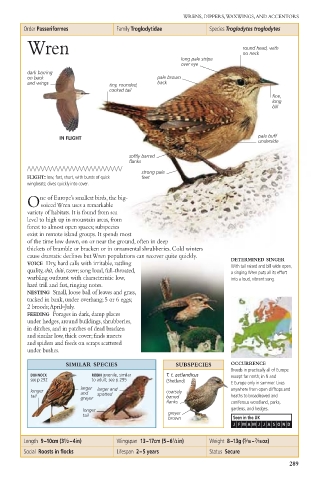
        Wren                                                 round head, with

                                              long pale stripe  no neck
                                              over eye
        dark barring
        on back                         pale brown
        and wings           tiny, rounded,  back
                            cocked tail
                                                                     fine,
                                                                     long
                                                                     bill


                                                                 pale buff
                IN FLIGHT
                                                                 underside
                                 softly barred
                                 flanks
                                    strong pale
        FLIGHT: low, fast, short, with bursts of quick  feet
        wingbeats; dives quickly into cover.
           ne of Europe’s smallest birds, the big-
        Ovoiced Wren uses a remarkable
        variety of habitats. It is found from sea
        level to high up in mountain areas, from
        forest to almost open spaces; subspecies
        exist in remote island groups. It spends most
        of the time low down, on or near the ground, often in deep
        thickets of bramble or bracken or in ornamental shrubberies. Cold winters
        cause dramatic declines but Wren populations can recover quite quickly.  DETERMINED SINGER
        VOICE Dry, hard calls with irritable, rattling    With tail raised and bill wide open,
        quality,chit, chiti,tzerrr;song loud,full-throated,  a singing Wren puts all its effort
        warbling outburst with characteristic low,        into a loud, vibrant song.
        hard trill and fast, ringing notes.
        NESTING Small, loose ball of leaves and grass,
        tucked in bank, under overhang; 5 or 6 eggs;
        2 broods;April–July.
        FEEDING Forages in dark, damp places
        under hedges, around buildings, shrubberies,
        in ditches, and in patches of dead bracken
        and similar low, thick cover; finds insects
        and spiders and feeds on scraps scattered
        under bushes.
                 SIMILAR SPECIES             SUBSPECIES   OCCURRENCE
                                                          Breeds in practically all of Europe
         DUNNOCK        ROBIN juvenile, similar  T. t. zetlandicus  except far north; in N and
         see p.292      to adult; see p.295  (Shetland)   E Europe only in summer. Lives
                     larger  larger and                   anywhere from open clifftops and
         longer      and                  coarsely
         tail        greyer  spotted      barred          heaths to broadleaved and
                                          flanks          coniferous woodland, parks,
                      longer                              gardens, and hedges.
                      tail                 greyer
                                           brown           Seen in the UK
                                                           J  F  M  A  M  JJ A S O  N  D
       Length  9–10cm (3 1 ⁄2 –4in)  Wingspan  13–17cm (5–6 1 ⁄2in)  Weight  8–13g ( 5 ⁄16 – 7 ⁄16oz)
       Social  Roosts in flocks  Lifespan  2–5 years  Status  Secure
                                                                         289

