


Page 293 - Complete Birds of Britain and Europe (DK - RSPB)
P. 293
WRENS, DIPPERS,WAXWINGS,AND ACCENTORS
       Order Passeriformes    Family Bombycillidae   Species Bombycilla garrulus
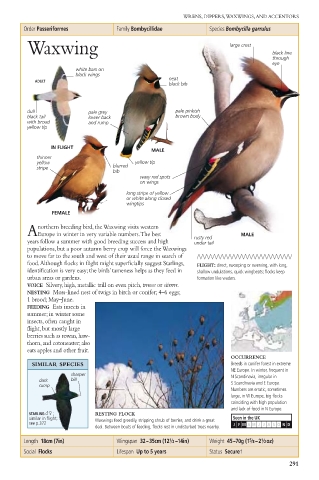
        Waxwing                                           large crest  black line

                                                                     through
                                                                     eye
                    white bars on
                    black wings
                                           neat
          ADULT
                                           black bib
        dull           pale grey             pale pinkish
        black tail     lower back            brown body
        with broad     and rump
        yellow tip
              IN FLIGHT
                                       MALE
          thinner
          yellow                   yellow tip
          stripe             blurred
                             bib
                                    waxy red spots
                                    on wings
                                long stripe of yellow
                                or white along closed
                                wingtips
              FEMALE
          northern breeding bird, the Waxwing visits western
        AEurope in winter in very variable numbers.The best  rusty red  MALE
        years follow a summer with good breeding success and high  under tail
        populations, but a poor autumn berry crop will force the Waxwings
        to move far to the south and west of their usual range in search of
        food.Although flocks in flight might superficially suggest Starlings,  FLIGHT: direct, swooping or swerving, with long,
        identification is very easy; the birds’ tameness helps as they feed in  shallow undulations, quick wingbeats; flocks keep
        urban areas or gardens.                   formation like waders.
        VOICE Silvery, high, metallic trill on even pitch, trrreee or siirrrrr.
        NESTING Moss-lined nest of twigs in birch or conifer; 4–6 eggs;
        1 brood; May–June.
        FEEDING Eats insects in
        summer; in winter some
        insects, often caught in
        flight, but mostly large
        berries such as rowan,haw-
        thorn,and cotoneaster;also
        eats apples and other fruit.
                                                          OCCURRENCE
         SIMILAR SPECIES                                  Breeds in conifer forest in extreme
                                                          NE Europe. In winter, frequent in
                   sharper                                N Scandinavia, irregular in
           dark    bill                                   S Scandinavia and E Europe.
           rump
                                                          Numbers are erratic, sometimes
                                                          large, in W Europe, big flocks
                                                          coinciding with high population
                                                          and lack of food in N Europe.
        STARLING 32;     RESTING FLOCK
        similar in flight;  Waxwings feed greedily, stripping shrub of berries, and drink a great  Seen in the UK
        see p.372                                          JF M A  M J  JA S O N D
                         deal. Between bouts of feeding, flocks rest in undisturbed trees nearby.
       Length  18cm (7in)     Wingspan  32–35cm (12 1 ⁄2 –14in)  Weight  45–70g (1 5 ⁄8 –2 1 ⁄2oz)
       Social  Flocks         Lifespan  Up to 5 years  Status  Secure†
                                                                         291

