


Page 294 - Complete Birds of Britain and Europe (DK - RSPB)
P. 294
WRENS, DIPPERS,WAXWINGS,AND ACCENTORS
       Order Passeriformes    Family Prunellidae     Species Prunella modularis
        Dunnock                                                brown eye
                                                    streaked
                                                    brown cap        fine dark
                                                                     bill
                    black streaks on
                    rich brown back        black and brown
                    and wings              streaks on back
                                                                      grey
                                         brown cheeks                 throat
                        mid-grey
                        breast
                                         soft, warm
                                         brown streaks
                                         on flanks
         IN FLIGHT
        line of pale          ADULT
        spots across
        wings
                            uneven, grey
                            and brown
                            streaking below
         JUVENILE
                                             orange-
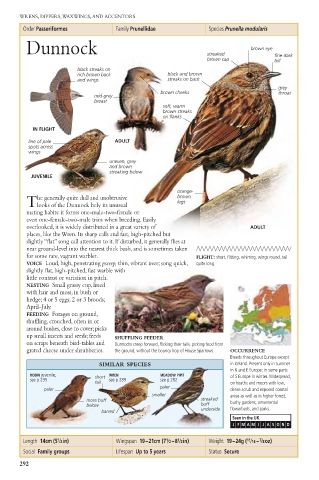
          he generally quite dull and unobtrusive  brown
        Tlooks of the Dunnock bely its unusual  legs
        mating habits: it forms one-male-two-female or
        even one-female-two-male trios when breeding. Easily
        overlooked, it is widely distributed in a great variety of  ADULT
        places, like the Wren. Its sharp calls and fast, high-pitched but
        slightly “flat” song call attention to it.If disturbed,it generally flies at
        near ground-level into the nearest thick bush, and is sometimes taken
        for some rare, vagrant warbler.           FLIGHT: short, flitting, whirring; wings round, tail
        VOICE Loud, high, penetrating pseeep, thin, vibrant teeee; song quick,  quite long.
        slightly flat, high-pitched, fast warble with
        little contrast or variation in pitch.
        NESTING Small grassy cup, lined
        with hair and moss, in bush or
        hedge; 4 or 5 eggs; 2 or 3 broods;
        April–July.
        FEEDING Forages on ground,
        shuffling, crouched, often in or
        around bushes,close to cover;picks
        up small insects and seeds; feeds   SHUFFLING FEEDER
        on scraps beneath bird-tables and  Dunnocks creep forward, flicking their tails, picking food from
        grated cheese under shrubberies.  the ground, without the bouncy hop of House Sparrows.  OCCURRENCE
                                                          Breeds throughout Europe except
                          SIMILAR SPECIES                 in Iceland. Present only in summer
                                                          in N and E Europe; in some parts
        ROBIN juvenile;   short  WREN    MEADOW PIPIT     of S Europe in winter. Widespread,
        see p.295           see p.289    see p.282
                         tail                             on heaths and moors with low,
                                         paler
            paler                                         dense scrub and exposed coastal
                                       smaller            areas as well as in higher forest,
                       more buff                   streaked  bushy gardens, ornamental
                       below                       buff
                                                   underside  flowerbeds, and parks.
                          barred
                                                           Seen in the UK
                                                           J  F  M  A  M  JJ A S O  N  D
       Length  14cm (5 1 ⁄2in)  Wingspan  19–21cm (7 1 ⁄2 –8 1 ⁄2in)  Weight  19–24g ( 11 ⁄16 – 7 ⁄8oz)
       Social  Family groups  Lifespan  Up to 5 years  Status  Secure
      292

