


Page 292 - Complete Birds of Britain and Europe (DK - RSPB)
P. 292
WRENS, DIPPERS,WAXWINGS,AND ACCENTORS
       Order Passeriformes    Family Cinclidae       Species Cinclus cinclus
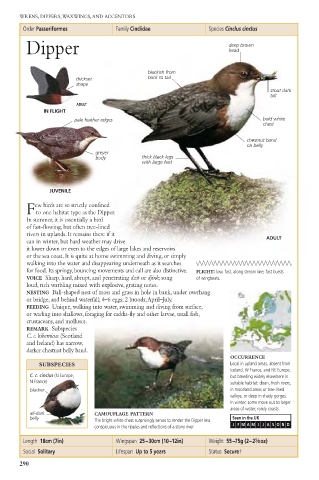
        Dipper                                            deep brown
                                                          head

                                      blackish from
                    thickset          back to tail
                    shape
                                                                    stout dark
                                                                    bill
                    ADULT
            IN FLIGHT
                    pale feather edges                            bold white
                                                                  chest
                                                              chestnut band
                                                              on belly
                         greyer
                         body       thick black legs
                                    with large feet


             JUVENILE
          ew birds are so strictly confined
        F to one habitat type as the Dipper.
        In summer, it is essentially a bird
        of fast-flowing, but often tree-lined
        rivers in uplands. It remains there if it                  ADULT
        can in winter, but hard weather may drive
        it lower down or even to the edges of large lakes and reservoirs
        or the sea coast. It is quite at home swimming and diving, or simply
        walking into the water and disappearing underneath as it searches
        for food. Its springy,bouncing movements and call are also distinctive.  FLIGHT: low, fast, along stream line; fast bursts
        VOICE Sharp, hard, abrupt, and penetrating dzit or djink; song   of wingbeats.
        loud, rich warbling mixed with explosive, grating notes.
        NESTING Ball-shaped nest of moss and grass in hole in bank, under overhang
        or bridge, and behind waterfall; 4–6 eggs; 2 broods;April–July.
        FEEDING Unique, walking into water, swimming and diving from surface,
        or wading into shallows, foraging for caddis-fly and other larvae, small fish,
        crustaceans, and molluscs.
        REMARK Subspecies
        C. c. hibernicus (Scotland
        and Ireland) has narrow,
        darker chestnut belly band.
                                                          OCCURRENCE
           SUBSPECIES                                     Local in upland areas, absent from
                                                          Iceland, W France, and NE Europe,
        C. c. cinclus (N Europe,                          but breeding widely elsewhere in
        N France)                                         suitable habitat: clean, fresh rivers,
        blacker                                           in moorland areas or tree-lined
                                                          valleys, or deep in shady gorges.
                                                          In winter, some move out to larger
                                                          areas of water, rarely coasts.
        all-dark        CAMOUFLAGE PATTERN
        belly                                              Seen in the UK
                        The bright white chest surprisingly serves to render the Dipper less
                        conspicuous in the ripples and reflections of a stony river.  J  F  M  A  M  JJ A S O  N  D
       Length  18cm (7in)     Wingspan  25–30cm (10–12in)  Weight  55–75g (2–2 5 ⁄8oz)
       Social  Solitary       Lifespan  Up to 5 years  Status  Secure†
      290

