


Page 297 - Complete Birds of Britain and Europe (DK - RSPB)
P. 297
CHATS AND THRUSHES
       Order Passeriformes    Family Turdidae        Species Erithacus rubecula
        Robin

                                                         mottled
                               big black eye
                                               small, fine  brown
                                               dark bill  body
                        bluish grey
                        sides of neck
                        and chest
                                                                     red
                                               orange-red            blotches
                                               breast                appear
                 soft, warm- to
                 olive-brown
                 upperparts
        ADULT
                                              olive-buff    JUVENILE
        IN FLIGHT
                                              underside
                                                             pale orange-red to
                                                             washed-out orange
                                                 spindly     face and breast
                                                 brown legs

         ADULT (SPRING)

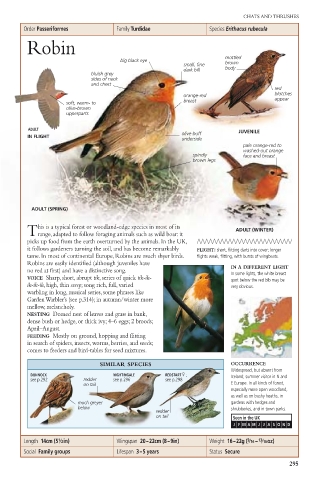
          his is a typical forest or woodland-edge species in most of its  ADULT (WINTER)
        Trange, adapted to follow foraging animals such as wild boar: it
        picks up food from the earth overturned by the animals. In the UK,
        it follows gardeners turning the soil, and has become remarkably  FLIGHT: short, flitting darts into cover; longer
        tame. In most of continental Europe, Robins are much shyer birds.  flights weak, flitting, with bursts of wingbeats.
        Robins are easily identified (although juveniles have
        no red at first) and have a distinctive song.     IN A DIFFERENT LIGHT
                                                          In some lights, the white breast
        VOICE Sharp, short, abrupt tik, series of quick tik-ik-  spot below the red bib may be
        ik-ik-ik, high, thin seeep; song rich, full, varied  very obvious.
        warbling in long, musical series, some phrases like
        Garden Warbler’s (see p.314); in autumn/winter more
        mellow, melancholy.
        NESTING Domed nest of leaves and grass in bank,
        dense bush or hedge, or thick ivy; 4–6 eggs; 2 broods;
        April–August.
        FEEDING Mostly on ground, hopping and flitting
        in search of spiders, insects, worms, berries, and seeds;
        comes to feeders and bird-tables for seed mixtures.
                          SIMILAR SPECIES                 OCCURRENCE
                                                          Widespread, but absent from
         DUNNOCK             NIGHTINGALE  REDSTART 2;     Iceland; summer visitor in N and
         see p.292    redder  see p.296   see p.298
                      on tail                             E Europe. In all kinds of forest,
                                                          especially more open woodland,
                                                          as well as on bushy heaths, in
                    much greyer                           gardens with hedges and
                    below                                 shrubberies, and in town parks.
                                        redder
                                        on tail            Seen in the UK
                                                           J  F  M  A  M  JJ A S O  N  D
       Length  14cm (5 1 ⁄2in)  Wingspan  20–22cm (8–9in)  Weight  16–22g ( 9 ⁄16 – 13 ⁄16oz)
       Social  Family groups  Lifespan  3–5 years    Status  Secure
                                                                         295

