


Page 298 - Complete Birds of Britain and Europe (DK - RSPB)
P. 298
CHATS AND THRUSHES
       Order Passeriformes    Family Turdidae        Species Luscinia megarhynchos
        Nightingale
                                                          spotted
                                                          above
                                                       rufous
                                                       tail
        rufous       plain brown     pale ring around
        tail         wings           large dark eye


                   ADULT
                           warm
        IN FLIGHT          brown back
                                                       grey on side  JUVENILE
                                                       of neck
                                                       clean grey-buff
                                                       underside
         tail often                                       bright
         raised                                           rump

          ADULT

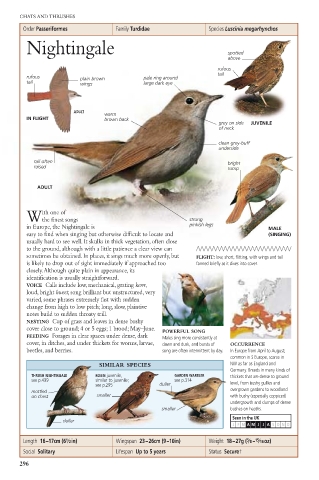
           ith one of
        Wthe finest songs                       strong
        in Europe, the Nightingale is           pinkish legs        MALE
        easy to find when singing but otherwise difficult to locate and  (SINGING)
        usually hard to see well. It skulks in thick vegetation, often close
        to the ground, although with a little patience a clear view can
        sometimes be obtained. In places, it sings much more openly, but   FLIGHT: low, short, flitting, with wings and tail
        is likely to drop out of sight immediately if approached too   fanned briefly as it dives into cover.
        closely.Although quite plain in appearance, its
        identification is usually straightforward.
        VOICE Calls include low, mechanical, grating kerrr,
        loud, bright hweet; song brilliant but unstructured, very
        varied, some phrases extremely fast with sudden
        change from high to low pitch; long, slow, plaintive
        notes build to sudden throaty trill.
        NESTING Cup of grass and leaves in dense bushy
        cover close to ground; 4 or 5 eggs; 1 brood; May–June.  POWERFUL SONG
        FEEDING Forages in clear spaces under dense, dark  Males sing more consistently at
        cover, in ditches, and under thickets for worms, larvae,  dawn and dusk, and bursts of  OCCURRENCE
        beetles, and berries.            song are often intermittent by day.  In Europe from April to August;
                                                          common in S Europe, scarce in
                          SIMILAR SPECIES                 NW as far as England and
                                                          Germany. Breeds in many kinds of
         THRUSH NIGHTINGALE  ROBIN juvenile,  GARDEN WARBLER  thickets that are dense to ground
         see p.439       similar to juvenile;  see p.314  level, from bushy gullies and
                         see p.295       duller
                                                          overgrown gardens to woodland
         mottled
         on chest        smaller                          with bushy (especially coppiced)
                                                          undergrowth and clumps of dense
                                         smaller          bushes on heaths.
                                                           Seen in the UK
                 duller
                                                           J  F  M  A  M  JJ A S O  N  D
       Length  16–17cm (6 1 ⁄2in)  Wingspan  23–26cm (9–10in)  Weight  18–27g ( 5 ⁄8 – 15 ⁄16oz)
       Social  Solitary       Lifespan  Up to 5 years  Status  Secure†
      296

