


Page 302 - Complete Birds of Britain and Europe (DK - RSPB)
P. 302
CHATS AND THRUSHES
       Order Passeriformes    Family Turdidae        Species Oenanthe oenanthe
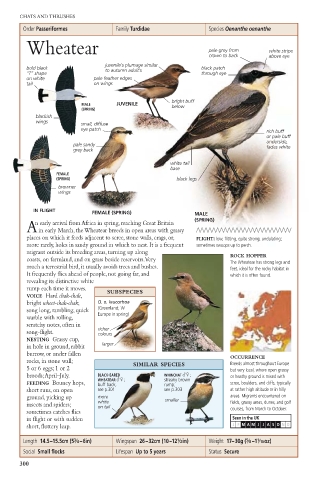
        Wheatear                                     pale grey from  white stripe
                                                     crown to back  above eye
                           juvenile’s plumage similar
        bold black         to autumn adult’s       black patch
        “T” shape                                  through eye
        on white        pale feather edges
        tail            on wings
                                            bright buff
                     MALE     JUVENILE      below
                     (SPRING)
          blackish
          wings
                     small, diffuse
                     eye patch
                                                                   rich buff
                                                                   or pale buff
                                                                   underside,
                   pale sandy                                      fades white
                   grey back
                                           white tail
                                           base
               FEMALE
               (SPRING)                      black legs
                browner
                wings
         IN FLIGHT
                        FEMALE (SPRING)          MALE
                                                 (SPRING)
          n early arrival from Africa in spring, reaching Great Britain
        A in early March, the Wheatear breeds in open areas with grassy
        places on which it feeds adjacent to scree, stone walls, crags, or,  FLIGHT: low, flitting, quite strong, undulating;
        more rarely, holes in sandy ground in which to nest. It is a frequent  sometimes swoops up to perch.
        migrant outside its breeding areas, turning up along
        coasts, on farmland, and on grass beside reservoirs.Very  ROCK HOPPER
                                                          The Wheatear has strong legs and
        much a terrestrial bird, it usually avoids trees and bushes.  feet, ideal for the rocky habitat in
        It frequently flies ahead of people, not going far, and  which it is often found.
        revealing its distinctive white
        rump each time it moves.  SUBSPECIES
        VOICE Hard chak-chak,
        bright wheet-chak-chak;  O. o. leucorhoa
        song long, rambling, quick  (Greenland; W
        warble with rolling,  Europe in spring)
        scratchy notes, often in
        song-flight.     richer
                         colours
        NESTING Grassy cup,
        in hole in ground, rabbit  larger
        burrow, or under fallen                           OCCURRENCE
        rocks, in stone wall;     SIMILAR SPECIES         Breeds almost throughout Europe
        5 or 6 eggs; 1 or 2                               but very local, where open grassy
        broods;April–July.  BLACK-EARED   WHINCHAT 32;    or heathy ground is mixed with
        FEEDING Bouncy hops,  WHEATEAR 32;  streaky brown  scree, boulders, and cliffs, typically
                                          rump;
                         buff back;
        short runs, on open  see p.301    see p.303       at rather high altitude or in hilly
        ground, picking up  more          smaller         areas. Migrants encountered on
        insects and spiders;  white                       fields, grassy areas, dunes, and golf
                         on tail
        sometimes catches flies                           courses, from March to October.
        in flight or with sudden                           Seen in the UK
        short, fluttery leap.                              J  F  M  A  M  JJ A S O  N  D
       Length  14.5–15.5cm (5 3 ⁄4 –6in)  Wingspan  26–32cm (10–12 1 ⁄2in)  Weight  17–30g ( 5 ⁄8 –1 1 ⁄16oz)
       Social  Small flocks   Lifespan  Up to 5 years  Status  Secure
      300

