


Page 303 - Complete Birds of Britain and Europe (DK - RSPB)
P. 303
CHATS AND THRUSHES
       Order Passeriformes    Family Turdidae        Species Oenanthe hispanica
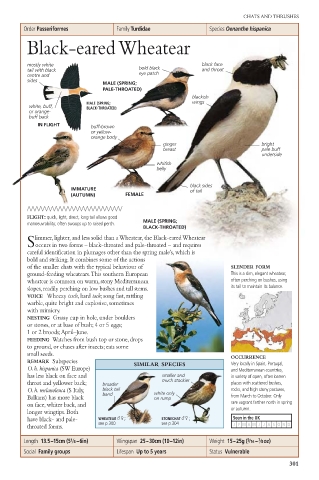
        Black-eared Wheatear


        mostly white                               black face
        tail with black             bold black     and throat
        centre and                  eye patch
        sides
                           MALE (SPRING;
                           PALE-THROATED)
                                                 blackish
                       MALE (SPRING;             wings
        white, buff,   BLACK-THROATED)
        or orange-
        buff back
          IN FLIGHT     buff-brown
                        or yellow-
                        orange body
                                          ginger                  bright
                                          breast                  pale buff
                                                                  underside
                                        whitish
                                        belly
                                                black sides
                   IMMATURE                     of tail
                   (AUTUMN)     FEMALE
        FLIGHT: quick, light, direct, long tail allows good
                                     MALE (SPRING;
        manoeuvrability; often swoops up to raised perch.
                                     BLACK-THROATED)
          limmer, lighter, and less solid than a Wheatear, the Black-eared Wheatear
        Soccurs in two forms – black-throated and pale-throated – and requires
        careful identification in plumages other than the spring male’s, which is
        bold and striking. It combines some of the actions
        of the smaller chats with the typical behaviour of  SLENDER FORM
        ground-feeding wheatears.This southern European   This is a slim, elegant wheatear,
        wheatear is common on warm,stony Mediterranean    often perching on bushes, using
                                                          its tail to maintain its balance.
        slopes,readily perching on low bushes and tall stems.
        VOICE Wheezy tssch, hard tack; song fast, rattling
        warble, quite bright and explosive, sometimes
        with mimicry.
        NESTING Grassy cup in hole, under boulders
        or stones, or at base of bush; 4 or 5 eggs;
        1 or 2 broods;April–June.
        FEEDING Watches from bush top or stone, drops
        to ground, or chases after insects; eats some
        small seeds.
                                                          OCCURRENCE
        REMARK Subspecies
                                  SIMILAR SPECIES         Very locally in Spain, Portugal,
        O.h.hispanica (SW Europe)                         and Mediterranean countries,
        has less black on face and       smaller and      in variety of open, often barren
                                         much stockier
        throat and yellower back;  broader                places with scattered bushes,
        O. h. melanoleuca (S Italy,  black tail           rocks, and high stony pastures,
                          band         white only
        Balkans) has more black        on rump            from March to October. Only
        on face, whiter back, and                         rare vagrant farther north in spring
                                                          or autumn.
        longer wingtips. Both
        have black- and pale-  WHEATEAR 32;  STONECHAT 32;   Seen in the UK
                         see p.300       see p.304
        throated forms.                                    JF M A  M J  JA S ON D
       Length  13.5–15cm (5 1 ⁄4 –6in)  Wingspan  25–30cm (10–12in)  Weight  15–25g ( 9 ⁄16 – 7 ⁄8oz)
       Social  Family groups  Lifespan  Up to 5 years  Status  Vulnerable
                                                                         301

