


Page 306 - Complete Birds of Britain and Europe (DK - RSPB)
P. 306
CHATS AND THRUSHES
       Order Passeriformes    Family Turdidae        Species Saxicola torquata
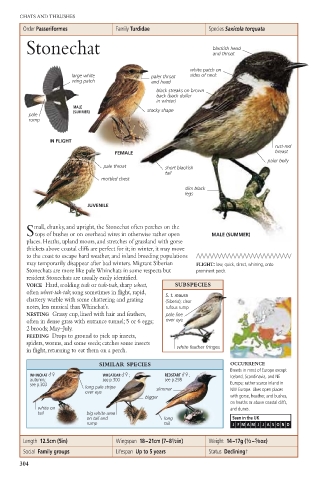
        Stonechat                                     blackish head
                                                      and throat
                                                white patch on
                   large white         paler throat  sides of neck
                   wing patch          and head
                                        black streaks on brown
                                        back (back duller
                                        in winter)
                   MALE               stocky shape
                   (SUMMER)
        pale
        rump
             IN FLIGHT
                                                                     rust-red
                              FEMALE                                 breast
                                                                   paler belly
                           pale throat    short blackish
                                          tail
                          mottled chest
                                               slim black
                                               legs
                       JUVENILE

          mall, chunky, and upright, the Stonechat often perches on the
        S tops of bushes or on overhead wires in otherwise rather open  MALE (SUMMER)
        places. Heaths, upland moors, and stretches of grassland with gorse
        thickets above coastal cliffs are perfect for it; in winter, it may move
        to the coast to escape hard weather, and inland breeding populations
        may temporarily disappear after bad winters. Migrant Siberian  FLIGHT: low, quick, direct, whirring, onto
        Stonechats are more like pale Whinchats in some respects but  prominent perch.
        resident Stonechats are usually easily identified.
        VOICE Hard, scolding tsak or tsak-tsak, sharp wheet,  SUBSPECIES
        often wheet-tak-tak; song sometimes in flight, rapid,  S. t. maura
        chattery warble with some chattering and grating  (Siberia); clear
        notes, less musical than Whinchat’s.  rufous rump
        NESTING Grassy cup, lined with hair and feathers,  pale line
        often in dense grass with entrance tunnel; 5 or 6 eggs;  over eye
        2 broods; May–July.
        FEEDING Drops to ground to pick up insects,
        spiders, worms, and some seeds; catches some insects
        in flight, returning to eat them on a perch.  white feather fringes
                          SIMILAR SPECIES                 OCCURRENCE
                                                          Breeds in most of Europe except
        WHINCHAT 32        WHEATEAR 32;   REDSTART 32;    Iceland, Scandinavia, and NE
        autumn;            see p.300      see p.298
        see p.303                                         Europe; rather scarce inland in
                      long pale stripe  slimmer           NW Europe. Likes open places
                      over eye
                                     bigger               with gorse, heather, and bushes,
                                                          on heaths or above coastal cliffs,
          white on                                        and dunes.
          tail         big white area
                       on tail and        long             Seen in the UK
                       rump               tail             J  F  M  A  M  JJ A S O  N  D
       Length  12.5cm (5in)   Wingspan  18–21cm (7–8 1 ⁄2in)  Weight  14–17g ( 1 ⁄2 – 5 ⁄8oz)
       Social  Family groups  Lifespan  Up to 5 years  Status  Declining†
      304

